1-800-366-1006
We apply our seal engineering expertise in ongoing research programs to develop new sealing materials that expand today's pressure/temperature capabilities and chemical compatibility design envelopes. Heat Treated (HT) versions of many products are available. These provide an increased stability under some elevated temperature conditions.
| Bal Seal Material | Operating Temperature Range °F (°C) | Tensile Strength at Break psi (kg/cm2) | Elongation at Break (molded direction) % | Color |
|---|---|---|---|---|
|
ER55 Polyester Elastomer
Used with poor mating surface finish where flexibility for excellent sealing ability is needed. For moist or wet food contact. For use at low speeds. FDA compliant and compatible.
|
-70 to 280
(-57 to 138)
|
2,370
(167)
|
520 | Black |
|
ER72 Polyester Elastomer
FDA compliant and compatible.
|
to 250
(to 121)
|
6,650
(467)
|
>300 | Black |
|
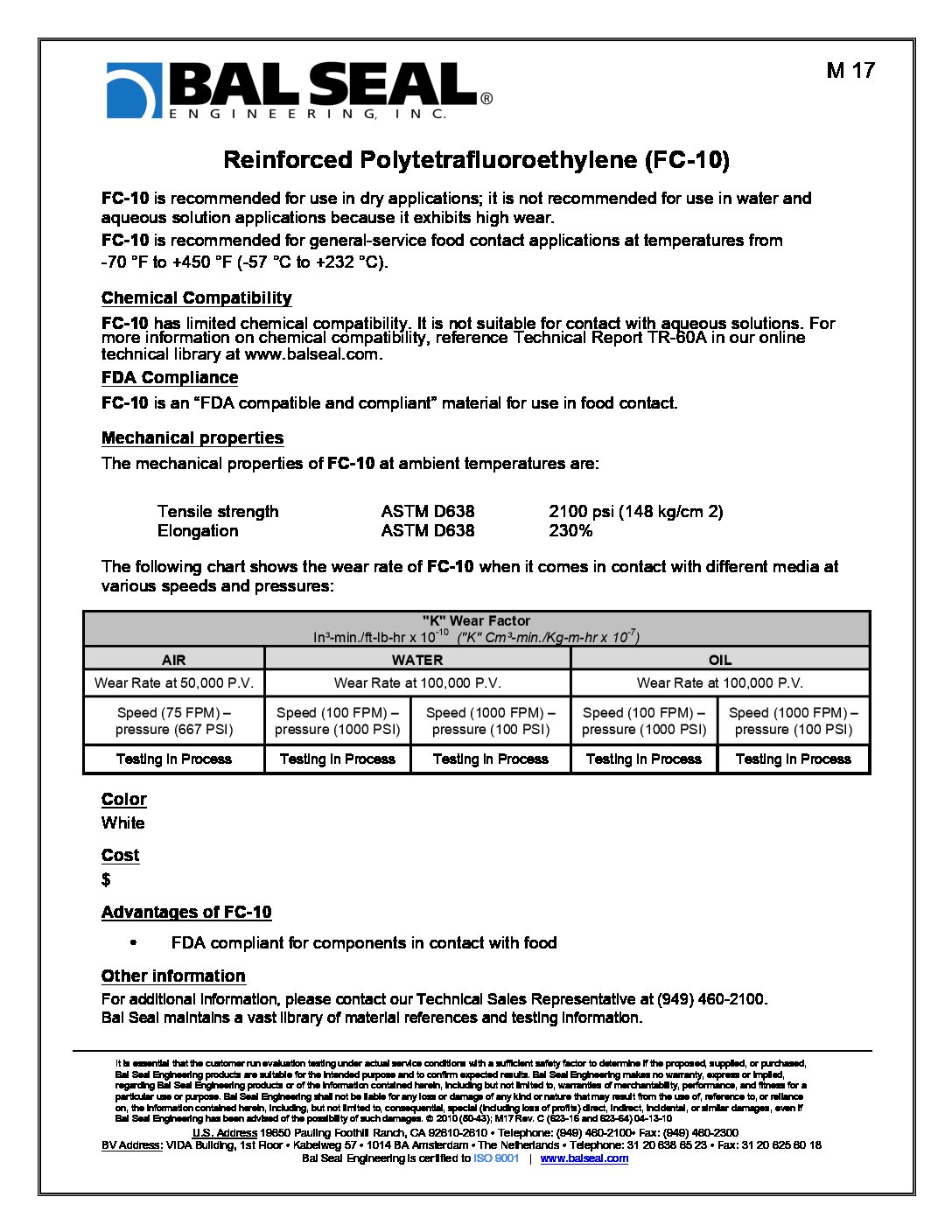
FC10 Reinforced PTFE
Used in dry applications. Exhibits high wear in water and aqueous solutions. FDA compliant and compatible.
|
-450 to 450
(-268 to 232)
|
2,900
(204)
|
340 | White |
|
FP Fluoropolymer
Fluoropolymer in rod/tube/plate form, compression molded. Not FDA compliant or compatible.
|
-70 to 390
(-57 to 199)
|
6,250
(439)
|
225 | White |
|
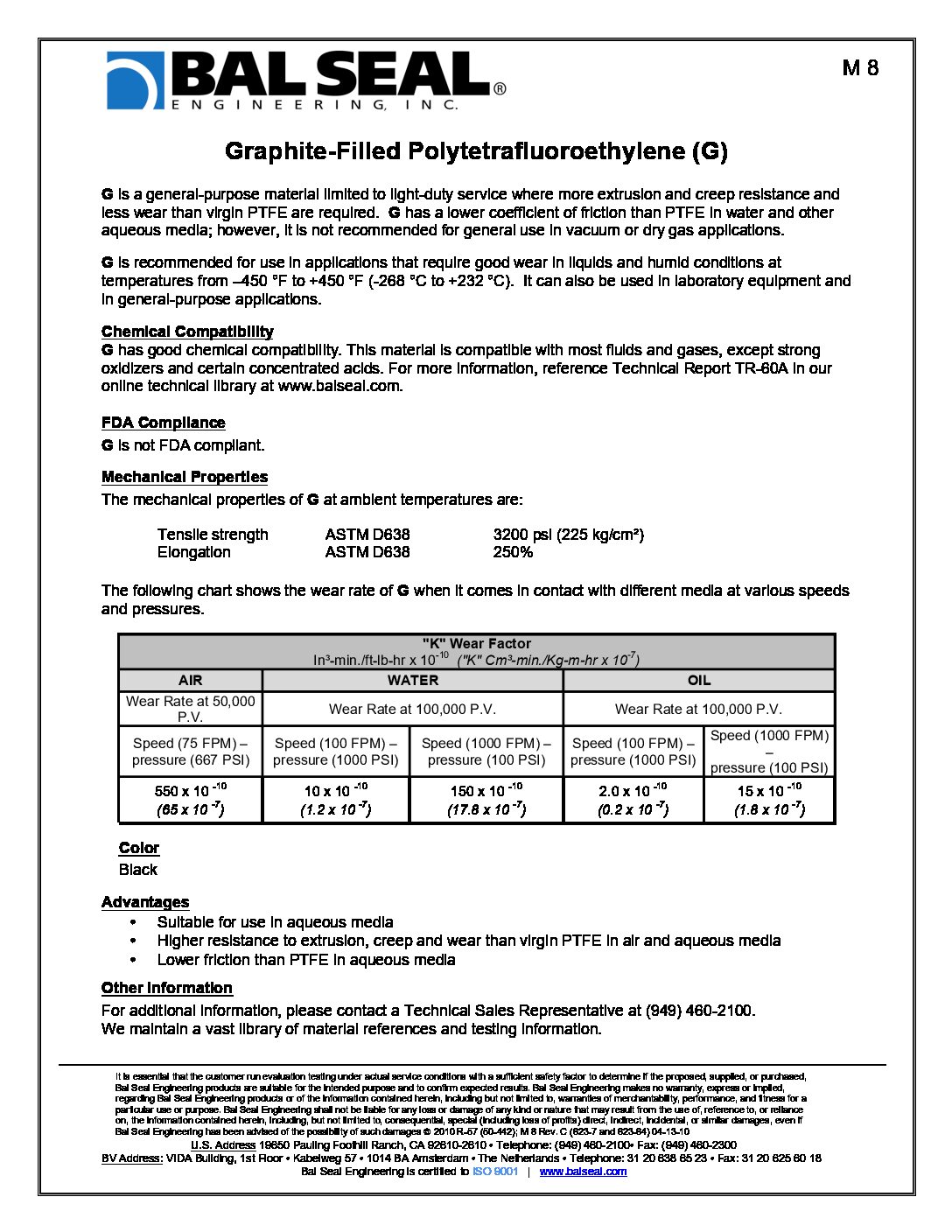
G Graphite PTFE
General-purpose application where more extrusion/creep-resistance and less wear than virgin PTFE are desired. G material is compatible with most fluids and gases except strong oxidizers and certain concentrated acids. Not for general use in vacuum or dry gases. Not FDA compliant or compatible.
|
-450 to 475
(-268 to 246)
|
3,800
(267)
|
325 | Grayish Black |
| Bal Seal Material | Operating Temperature Range °F (°C) | Tensile Strength at Break psi (kg/cm2 | Elongation at Break (molded direction) % | Color |
|---|---|---|---|---|
|
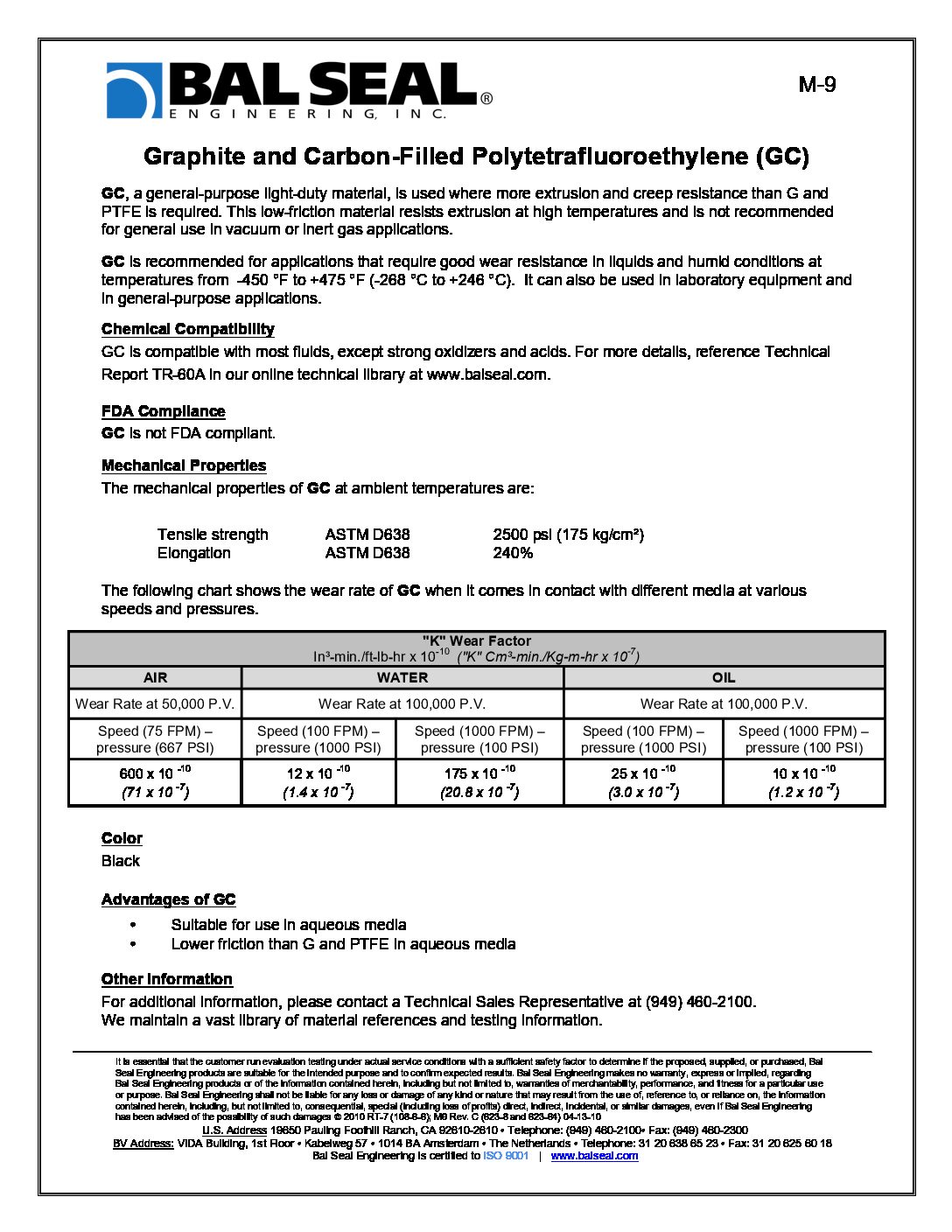
GC Graphite-Carbon PTFE
General-purpose application where extrusion/creep resistance is important. Resists deformation at high temperatures. Not for general use in vacuum or inert gases. Not FDA compliant or compatible.
|
-450 to 500
(-268 to 260)
|
4,100
(288)
|
325 | Grayish Black |
|
GC65 Graphite-Carbon-Filled PTFE
Compression molded, carbon, graphite, and PTFE. Not FDA compliant or compatible.
|
-450 to 500
(-268 to 260)
|
3,000
(211)
|
250 | Black |
|
GF Graphite-Fiber-Reinforced PTFE
Fiber-reinforced PTFE provides improved wear and extrusion resistance over other general-purpose compounds. Not FDA compliant or compatible.
|
-450 to 500
(-268 to 260)
|
3,200
(225)
|
300 | Grayish Black |
|
GF5 Glass-Fiber-Reinforced PTFE with Lubricant
Glass Fiber, MoS2-reinforced PTFE (compression molded). Not FDA compliant or compatible.
|
-450 to 500
(-268 to 260)
|
2,100
(148)
|
150 | Black |
|
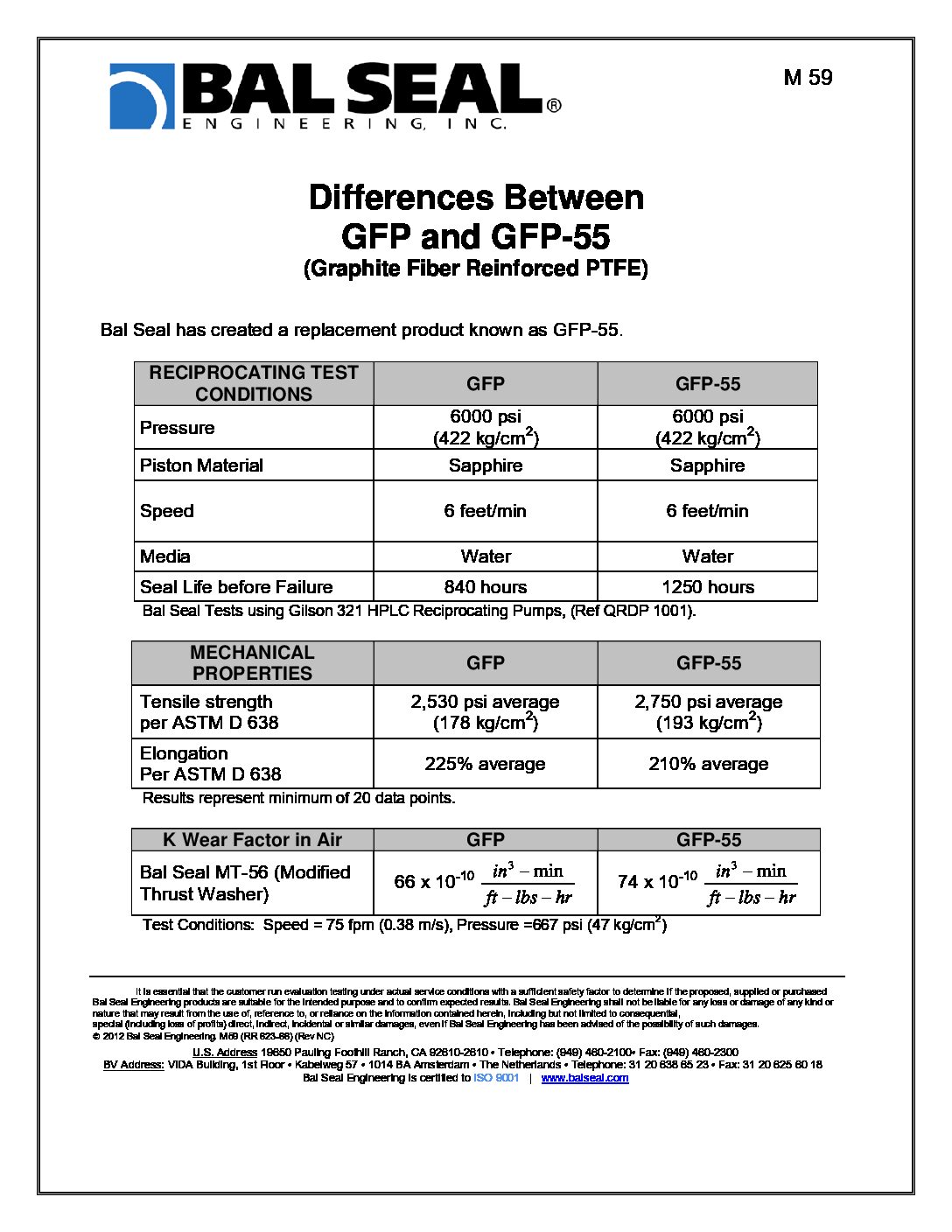
GFP Graphite-Fiber PTFE Reinforced
Moderate to extreme service, excellent wear resistance at moderate speeds, high pressure and high temperatures. Excellent for use in water and other liquid solutions, dynamic surfaces. Should be Rc 40 or higher. Limited use in vacuum and inert gases. Not FDA compliant or compatible
|
-450 to 500
(-268 to 260)
|
2,000
(141)
|
175 |
Black |
| Bal Seal Material | Operating Temperature Range °F (°C) | Tensile Strength at Break psi (kg/cm2) | Elongation at Break (molded direction) % | Color |
|---|---|---|---|---|
|
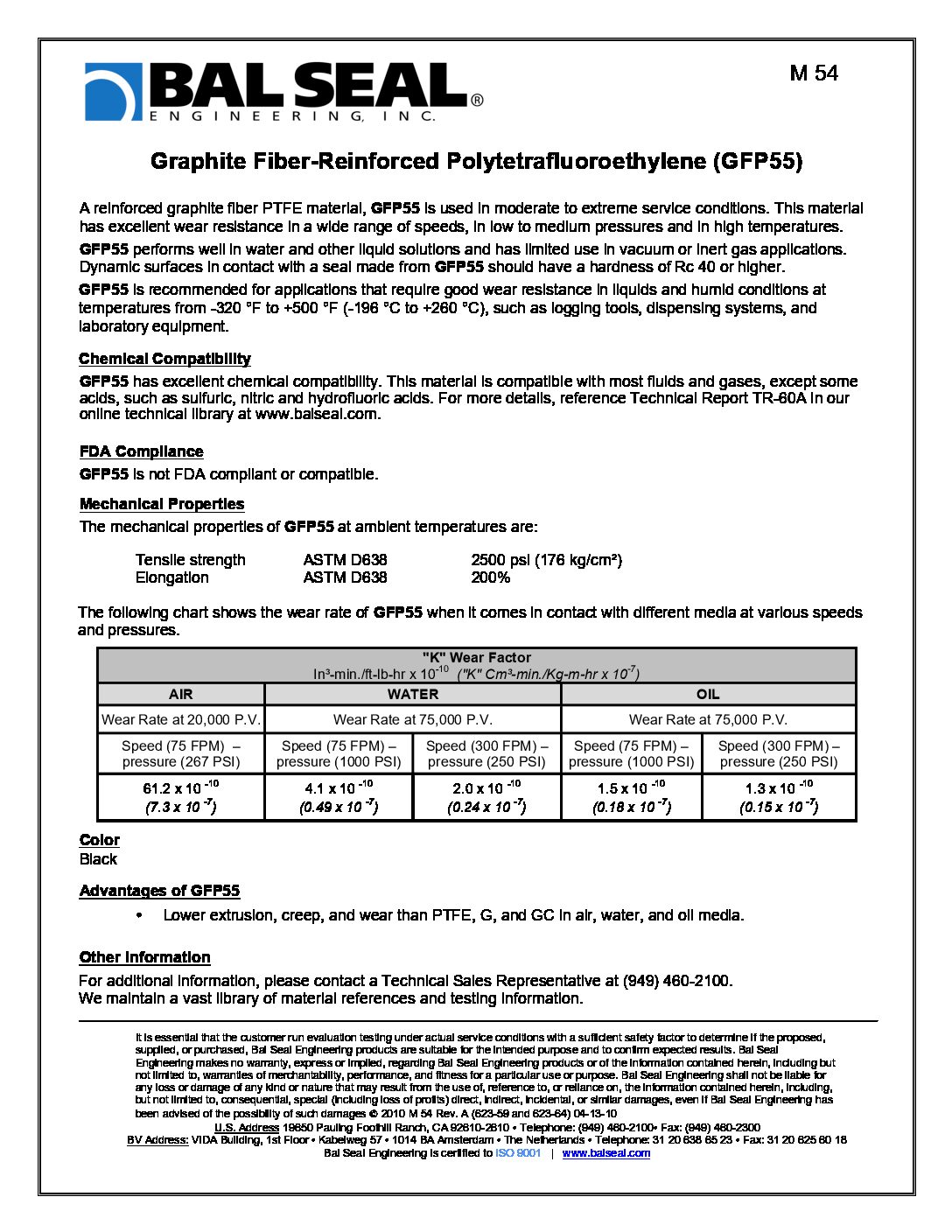
GFP55 Graphite-Fiber-Reinforced PTFE
Moderate to extreme service conditions of high pressure, high temperature at moderate speed. Good for applications in liquids and humid conditions. Not for general use in vacuum or inert gases. Not FDA compliant or compatible.
|
-450 to 500
(-268 to 260)
|
2,750
(193)
|
240 | Black |
|
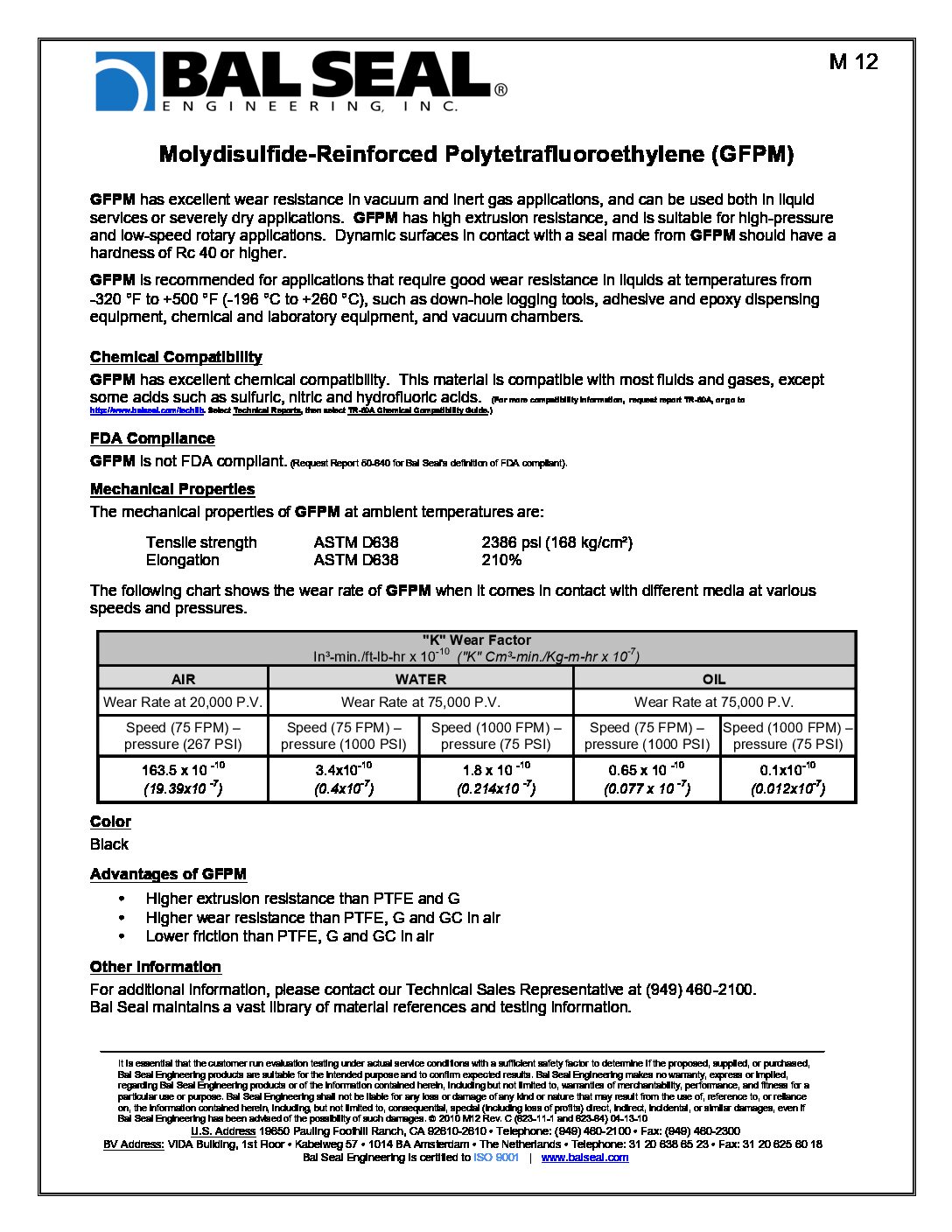
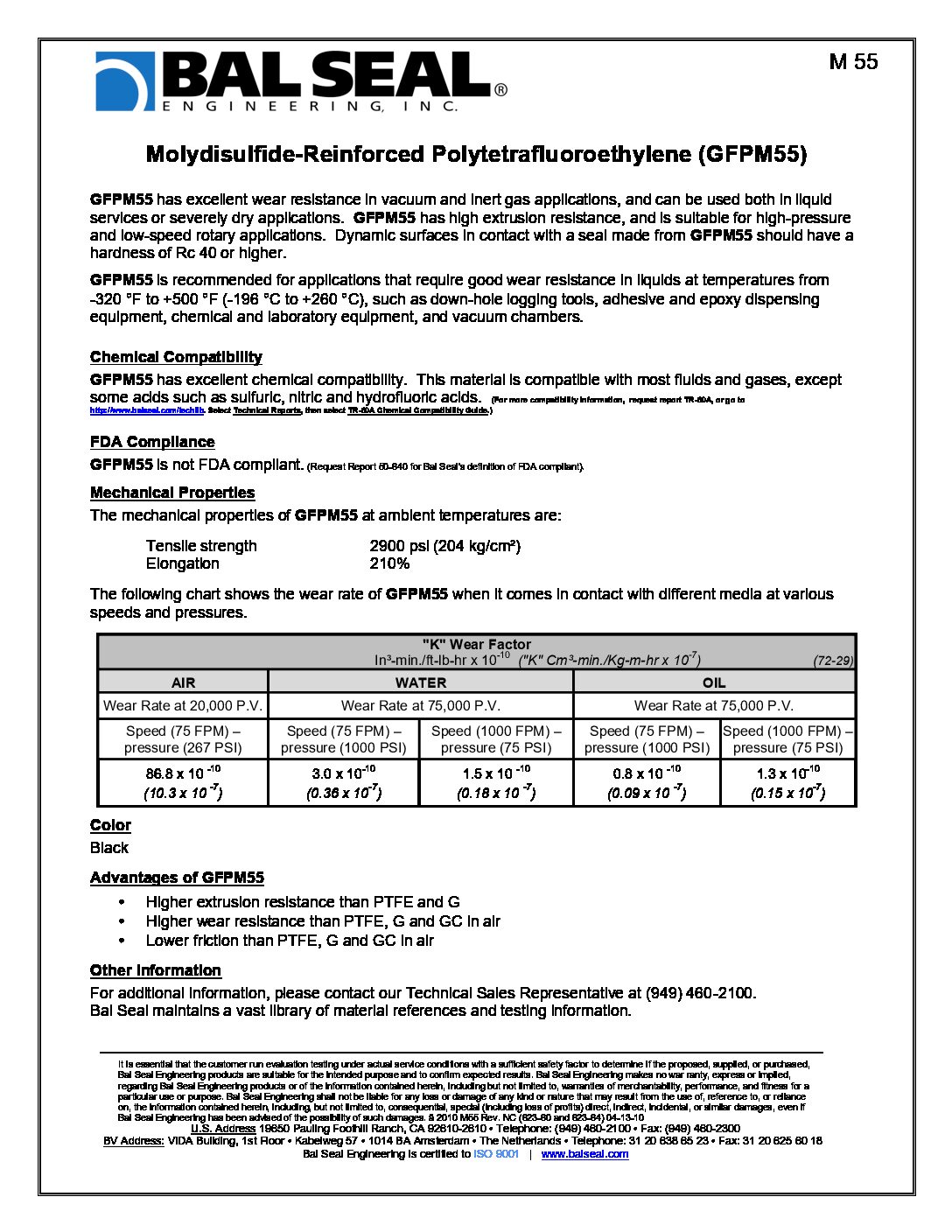
GFPM55 Molydisulfide-Reinforced PTFE
Severe dry and liquid service. Excellent wear and extrusion resistance in liquids, inert gases, and vacuum. Suitable for high-pressure and low-speed rotary applications. Not FDA compliant or compatible.
|
-450 to 500
(-268 to 260)
|
3,350
(236)
|
225 | Black |
|
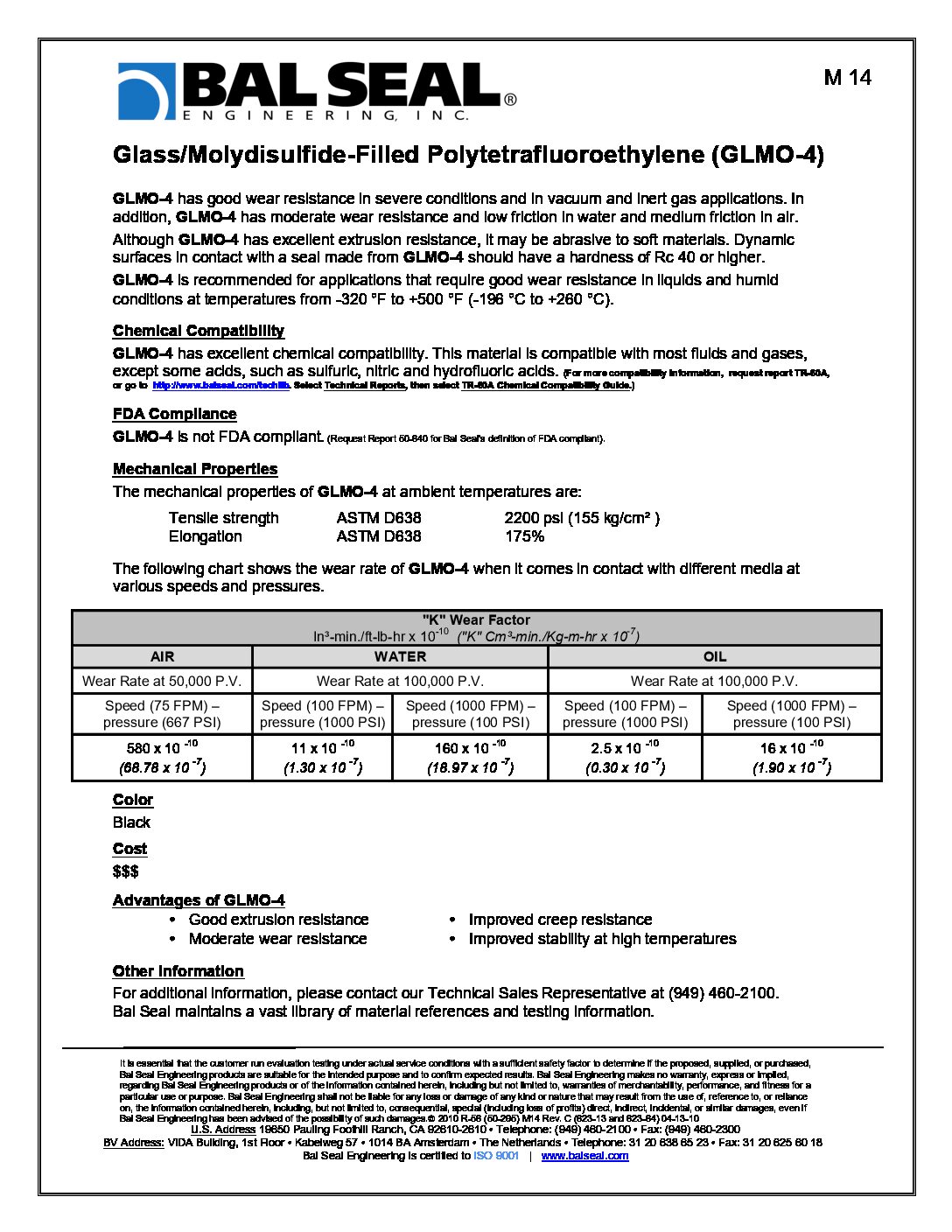
GLMO4 Molydisulfide PTFE
Good wear resistance in vacuum and inert gases. Moderate wear resistance with low friction. Not FDA compliant or compatible.
|
-450 to 500
(-268 to 260)
|
3,500
(246)
|
300 | Black |
|
MOS Reinforced PTFE with Lubricant
Self-lubricating molydisulfide-filled PTFE. Not FDA compliant or compatible.
|
-450 to 500
(-268 to 232)
|
3,800
(267)
|
350 | Black |
|
P150 High-Performance Polymer
Bearing-grade polyimide. Not FDA compliant or compatible.
|
to 500
(to 260)
|
11,000
(773)
|
3
|
Grayish Black |
|
P170 HT High-Performance Polymer Blend
Higher-temperature PEEK blend. Designed for glue dispensers. Not recommended for low to moderate temperature applications. Not FDA compliant or compatible.
|
200 to 600
(93 to 315)
|
17,000
(1195)
|
6 | Dark Brown |
|
P181 High-Performance Polymer
Polyimide material with good toughness, low water absorption, good wear and chemical resistance, and excellent stability against oxidation. Useful in scraping, low-speed, high-temperature applications.
|
-450 to 570
(-268 to 299)
|
18,900
(1329)
|
4 |
Yellow |
| Bal Seal Material | Operating Temperature Range °F (°C) | Tensile Strength at Break psi (kg/cm2 | Elongation at Break (molded direction) % | Color |
|---|---|---|---|---|
|
P240 High-Performance Polymer with Lubricant
Lubricated high-performance polymer blend, injection molded or extruded. Not FDA compliant or compatible.
|
to 570
(to 299)
|
8,700
(193)
|
>1 | Black |
|
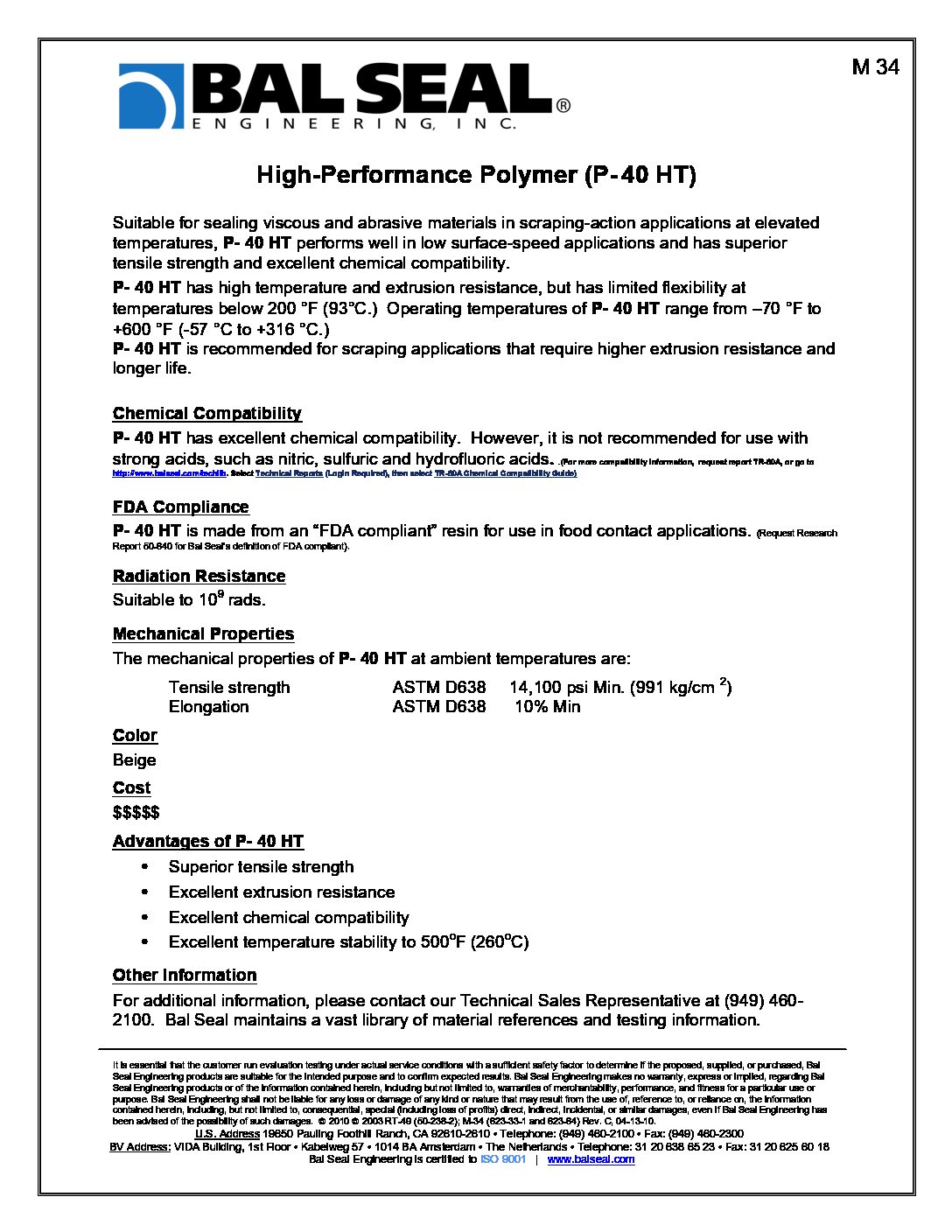
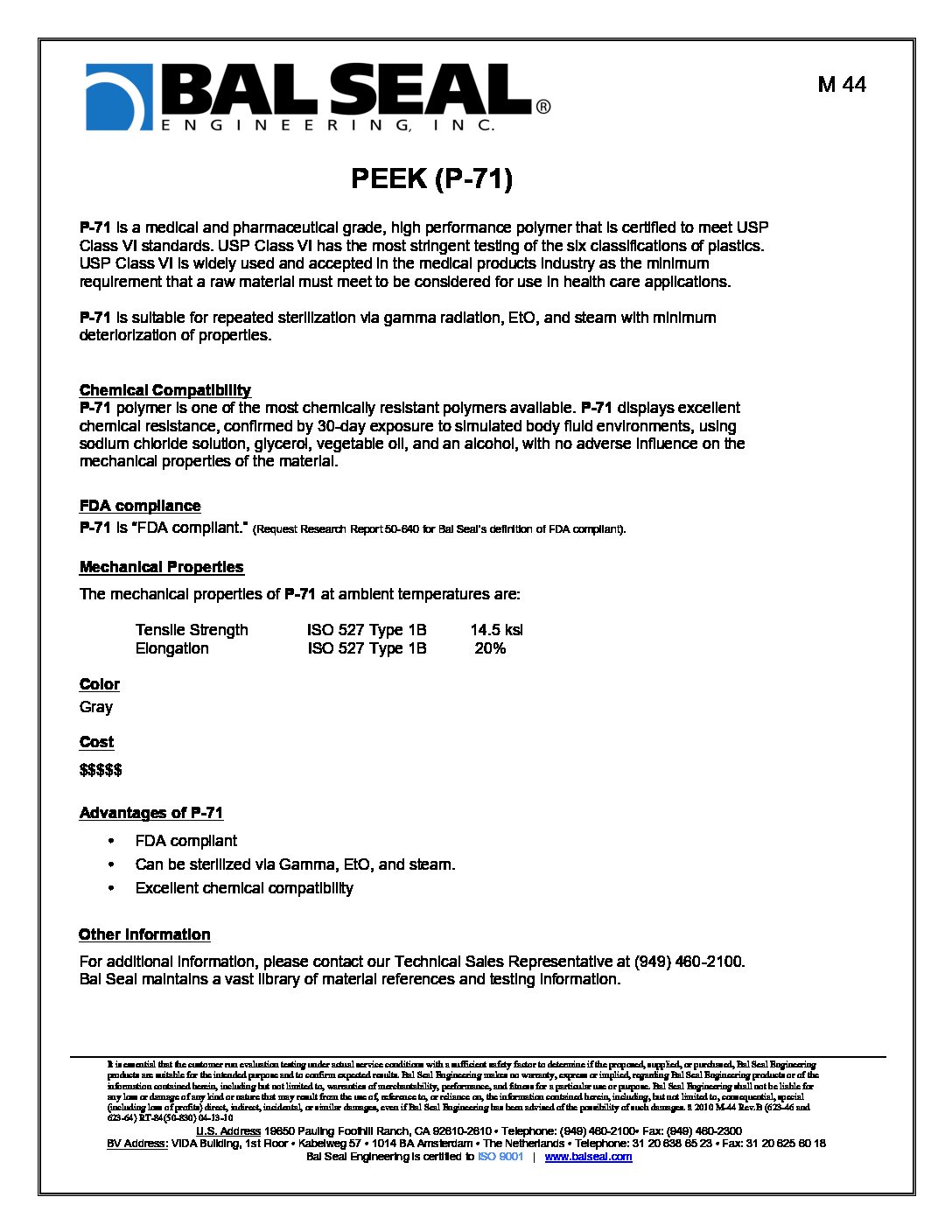
P40 HT High-Performance Polymer
Superior tensile strength and chemical compatibility. Suitable for sealing viscous and abrasive material in scraping-action applications at high temperatures. FDA compliant and compatible.
|
-70 to 600
(-57 to 316)
|
14,500
(1019)
|
>2 | Beige |
|
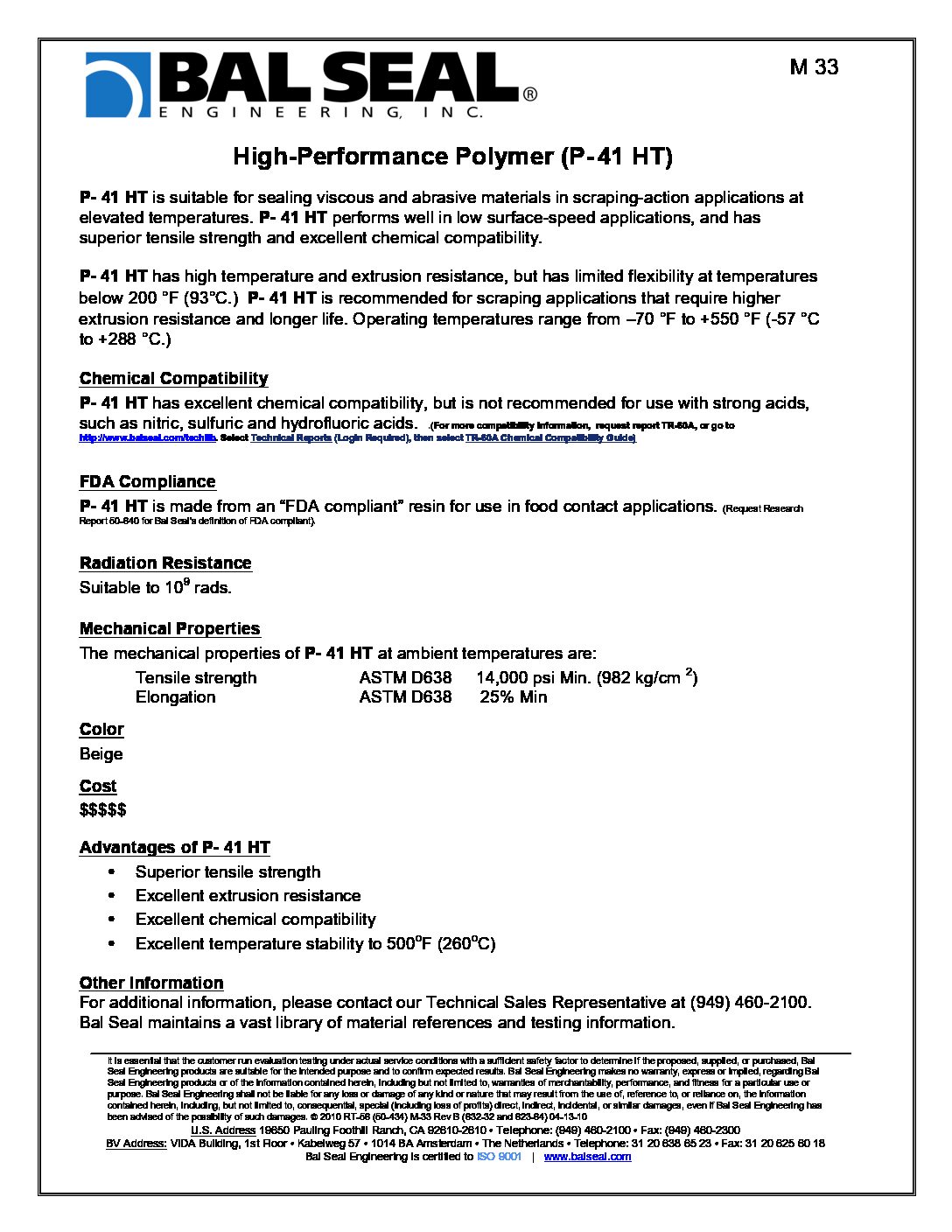
P41 HT High-Performance Polymer
Superior tensile strength and chemical compatibility. Suitable for sealing viscous and abrasive material in scraping-action applications at high temperatures. FDA compliant and compatible.
|
-70 to 600
(-57 to 316)
|
14,500
(1019)
|
>2 | Beige |
|
P60 Mineral-Filled PTFE
Mineral-filled PTFE compound. It exhibits superior dimensional stability and creep resistance as compared with Virgin PTFE and graphite-filled compounds. P-60 is designed for service in FDA-regulated applications, and is non-permeable in steam (good for autoclave applications). This compound exhibits low friction, minimal wear, and non-particulate/low shedding, and it is well suited for rotary and reciprocating equipment applications.
|
-320 to 500
(-196 to 260)
|
1,300
(91)
|
14 | White/Off White |
|
P64 PCTFE Fluoropolymer
PCTFE fluoropolymer useful for cryogenic valve seat applications. Good retention of properties at cryogenic temperatures.
|
-400 to 400
(-240 to 204)
|
4,000
(281)
|
140
|
White |
|
P66 HT High-Performance Polymer Carbon Fiber-Reinforced
Designed for applications that require tolerance for high temperature, high pressure, and chemical compatibility. Ability to flex at low and high pressures, and elevated temperatures. Not FDA compliant or compatible.
|
-70 to 600
(-57 to 316)
|
15,000
(1054)
|
>1 | Black |
|
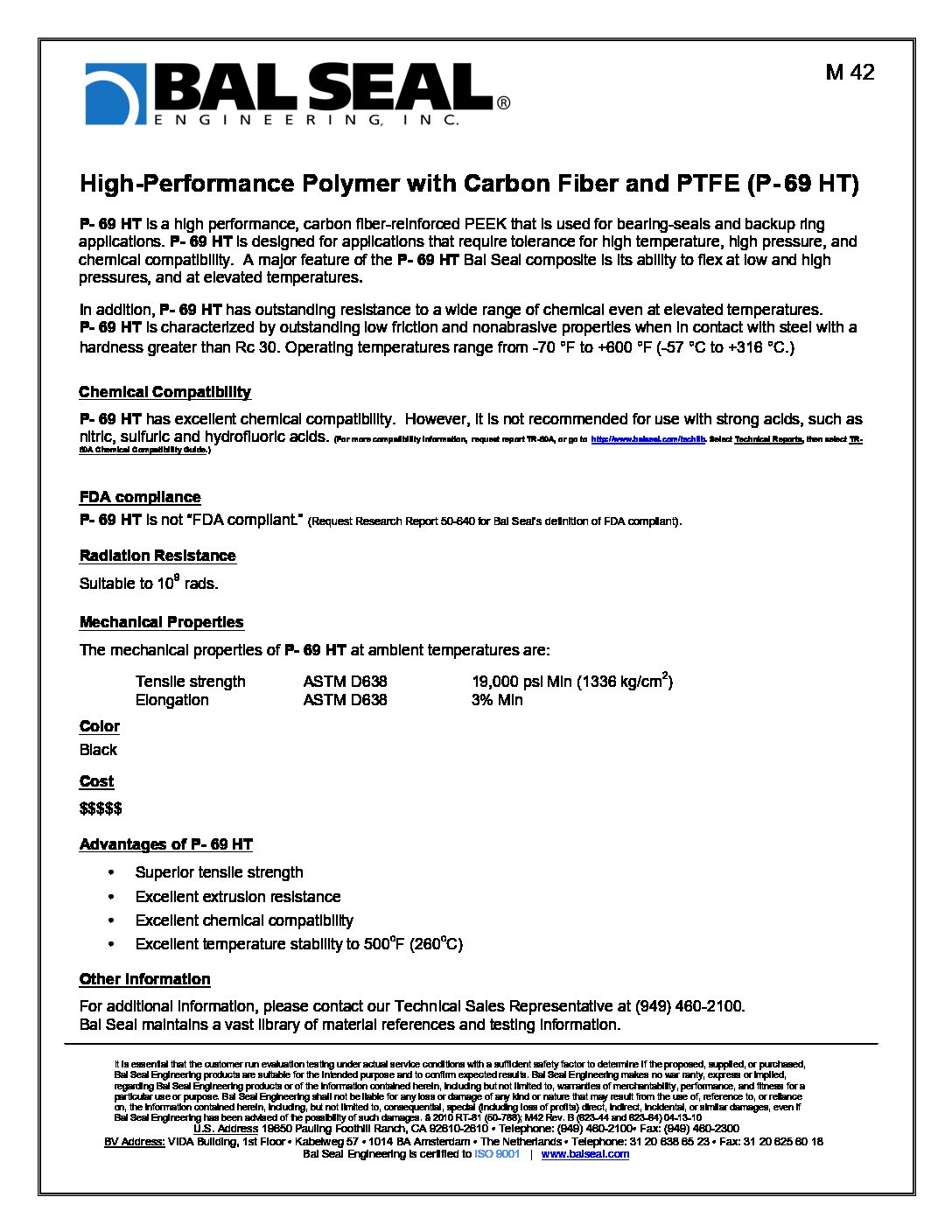
P69 HT High-Performance Polymer with Lubricant
High-performance polymer – carbon/PTFE-filled PEEK. Not FDA compliant or compatible.
|
-70 to 600
(-57 to 316)
|
13,500
(949)
|
4 |
Black |
| Bal Seal Material | Operating Temperature Range °F (°C) | Tensile Strength at Break psi (kg/cm2 | Elongation at Break (molded direction) % | Color |
|---|---|---|---|---|
|
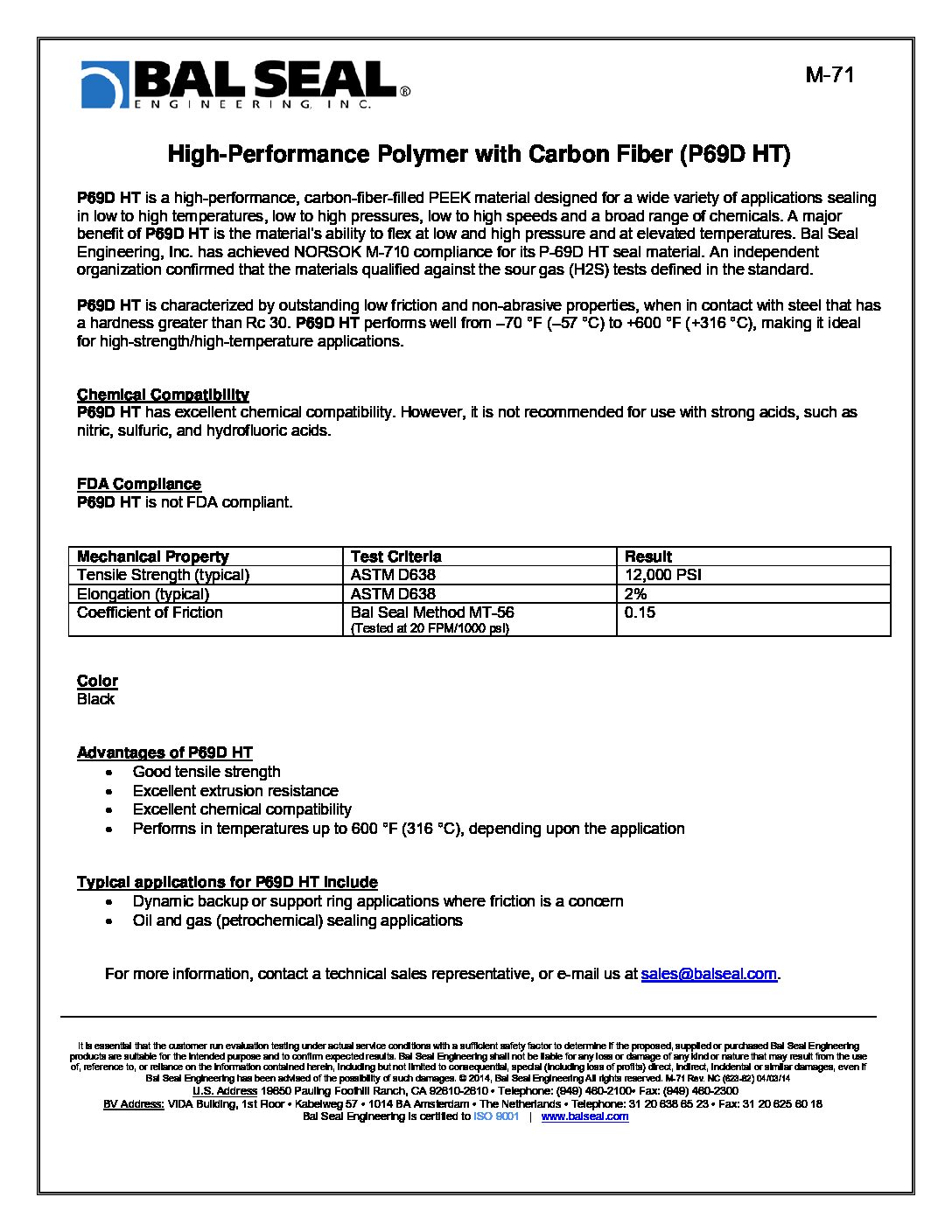
P69D HT High-Performance Polymer with Carbon Fiber and PTFE
Used for bearing seals and backup ring applications. Tolerance for high temperatures and pressure; excellent chemical compatibility. Not FDA compliant or compatible.
|
-70 to 600
(-57 to 316)
|
13,300
(935)
|
2 | Black |
|
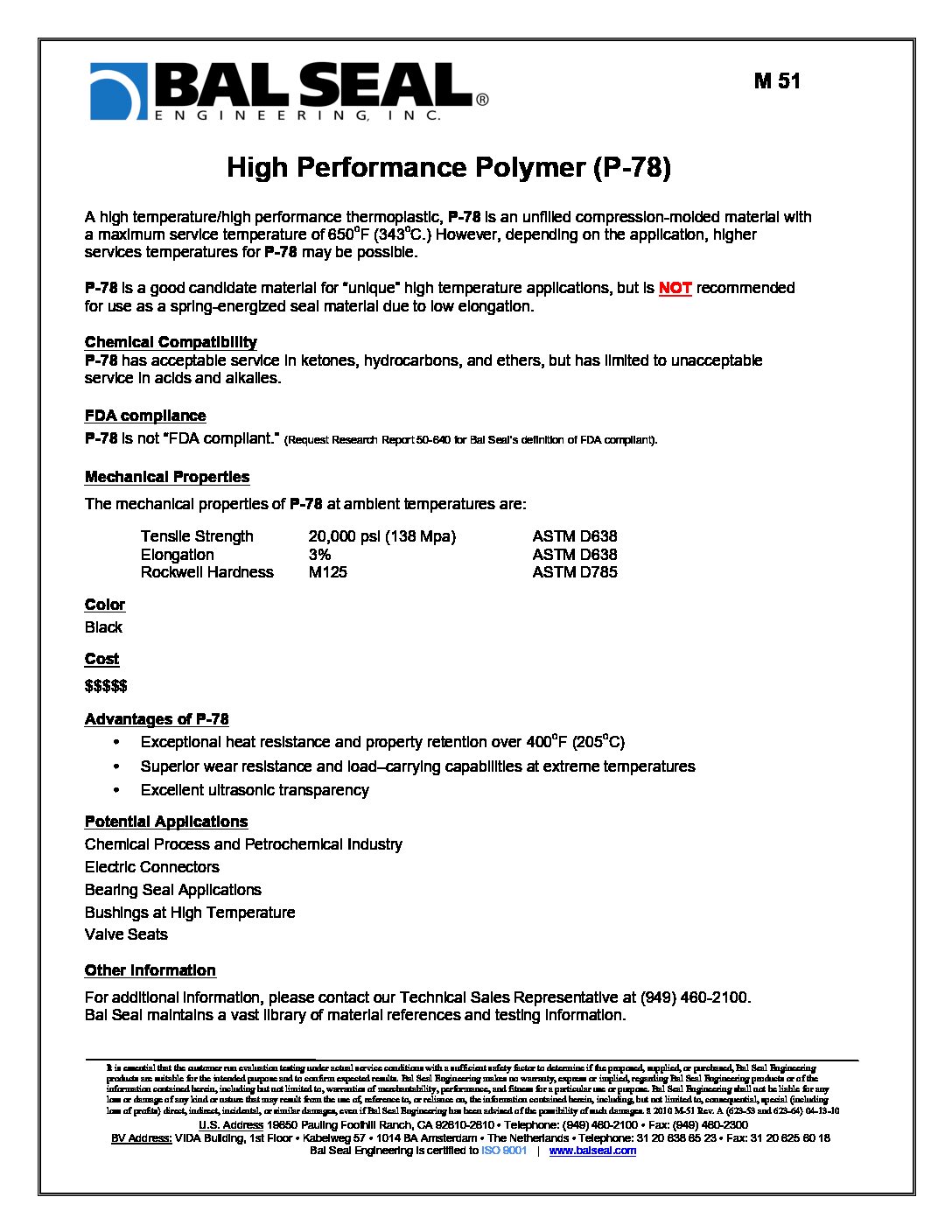
P78 High-Temperature Polymer
Used for demanding applications. High friction; limited uses
|
to 650
(343)
|
23,000
(1617)
|
3 | Dark Brown |
|
PFA Fluoropolymer
Thermoplastic PFA (Perfluoroalkoxy) extruded. Can be welded. FDA compliant and compatible.
|
to 500
(to 260)
|
3,600
(253)
|
300 | Translucent White |
|
SP191 Polymer-Filled PTFE
High-performance PTFE composition. For oxygen intensifier/compressor applications. FDA compliant and compatible.
|
-450 to 500
(-267 to 260)
|
3,000
(211)
|
315 | Yellow/Tan |
|
SP210 Static Dissipative PTFE
|
-450 to 500
(-268 to 260)
|
4,800
(337)
|
250 | Black |
|
SP23 Polymer-Filled PTFE
Good for moist or wet food contact applications. Low abrasion to soft mating parts.
|
-450 to 500
(-268 to 260)
|
2,600
(183)
|
250
|
Brown |
|
SP31 Polymer-Filled PTFE
|
-450 to 500
(-268 to 260)
|
2,550
(179)
|
275 | Brown |
|
SP36 Polymer-Filled PTFE
Superior heat and wear resistance. Well suited for rotary service. Recommended for low- to high-speed applications when running against soft metals. Not FDA compliant or compatible. Same as SP5 but only in smaller sizes.
|
-450 to 500
(-268 to 260)
|
3,000
(211)
|
350 |
Tan |
| Bal Seal Material | Operating Temperature Range °F (°C) | Tensile Strength at Break psi (kg/cm2 | Elongation at Break (molded direction) % | Color |
|---|---|---|---|---|
|
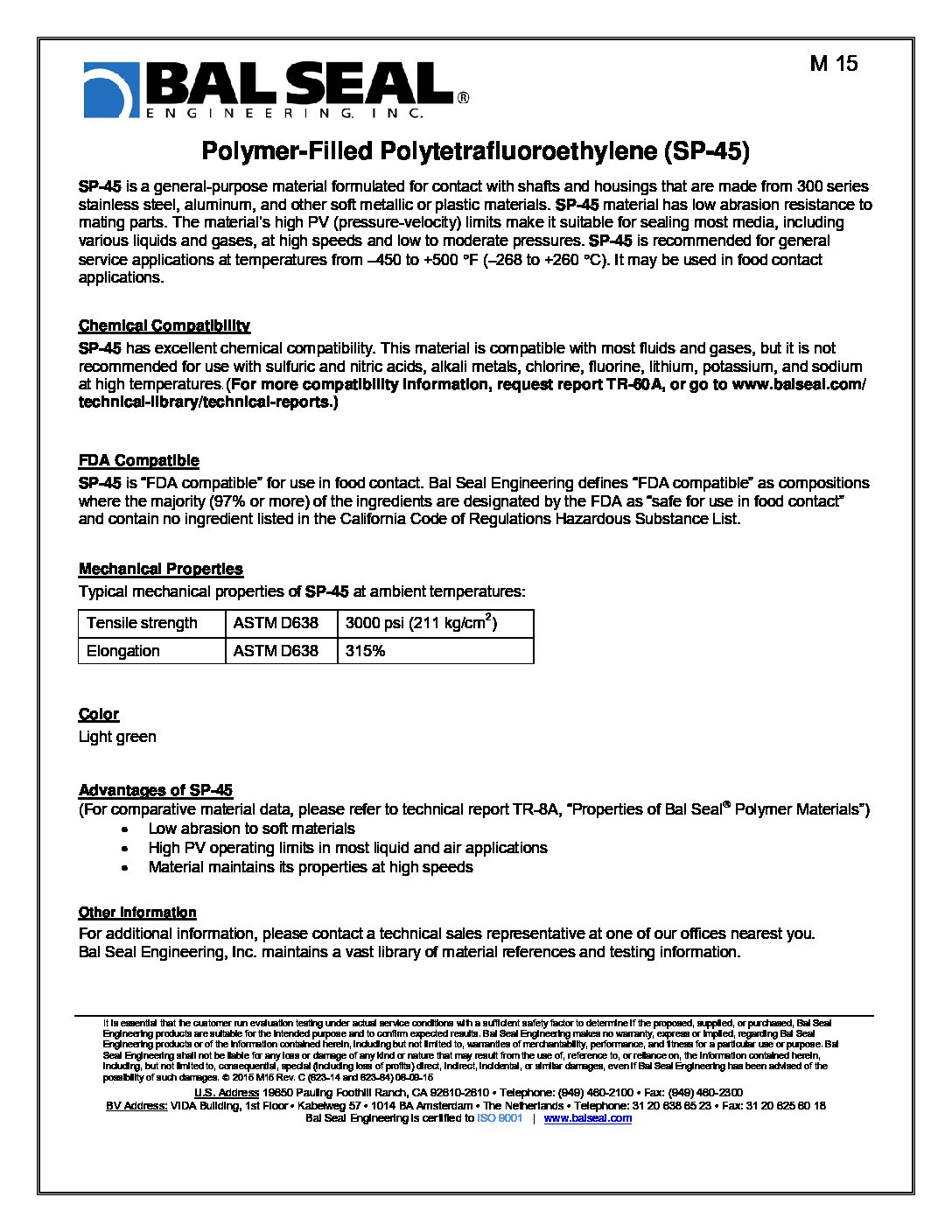
SP45 HT Polymer-Filled PTFE
Low abrasion to mating parts. General-purpose material for use in contact with shaft/housing made from 300 series stainless steel, aluminum and other soft metallic or plastic materials.Suitable for sealing most liquid media including moisture, air at high speed-low pressure with very high PV values. FDA compliant and compatible.
|
-450 to 500
(-268 to 260)
|
3,000
(211)
|
315 | Green |
|
SP5 Polymer-Filled PTFE
Superior heat and wear resistance. Well suited for rotary service. Recommended for low- to high-speed applications when running against soft metals. Not FDA compliant or compatible.
|
-450 to 500
(-268 to 260)
|
3,000
(211)
|
350 | Tan |
|
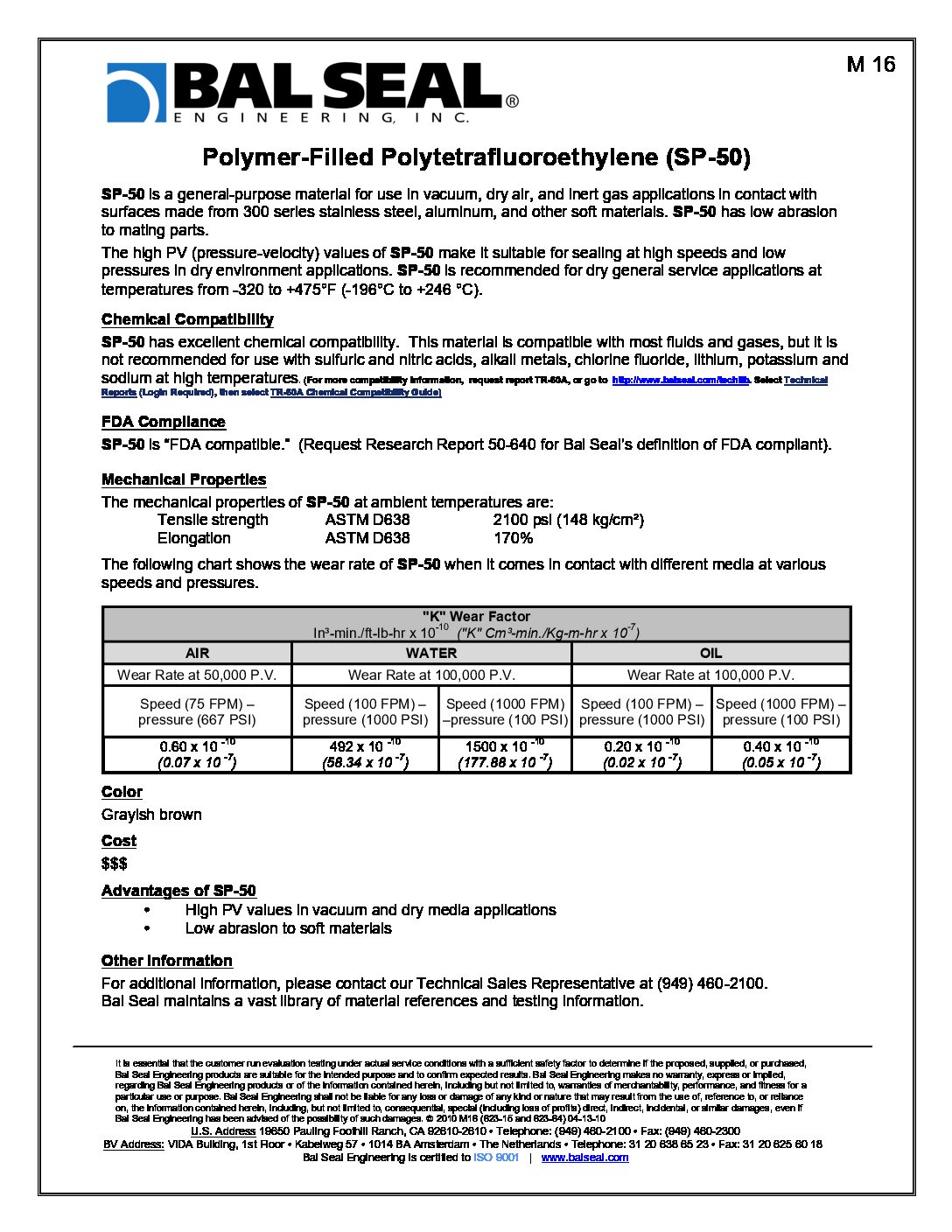
SP50 Polymer-Filled PTFE
Low abrasion to mating parts. General-purpose material for use in vacuum, air, and inert gases in contact with soft materials like 300 series stainless steel, aluminum, and other soft metallic and plastic materials. Ideally suited for high speed-low pressure at very high PV value. FDA compliant and compatible.
|
-450 to 500
(-268 to 260)
|
2,050
(144)
|
215 | Grayish Brown |
|
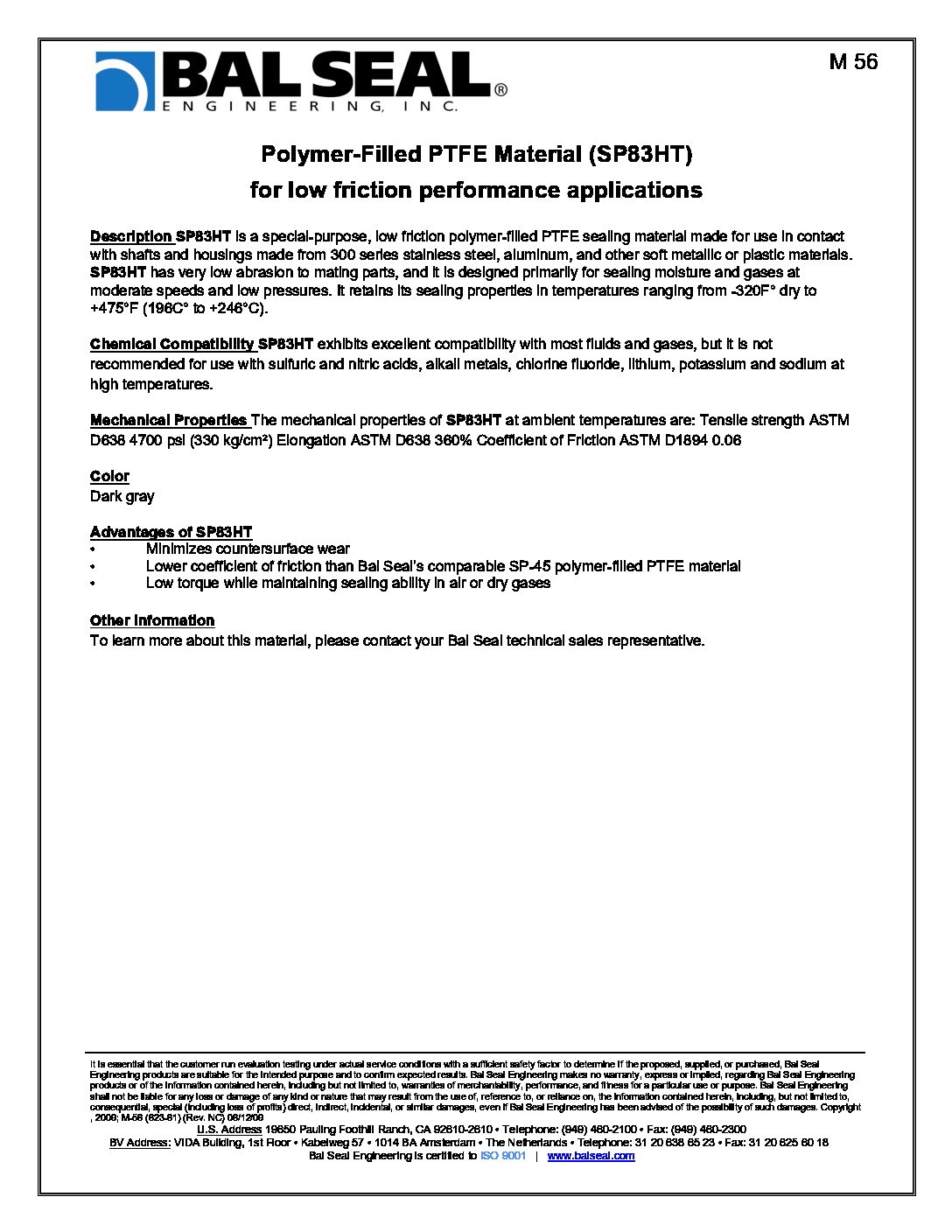
SP83HT Polymer-Filled PTFE
A special-purpose, low friction polymer-filled PTFE sealing material made for use in contacts with shafts and housings made from 300 series stainless steel, aluminum, and other soft metallic or plastic materials. SP83 HT has very low abrasion to mating parts, and it is designed primarily for sealing moisture and gases at moderate speeds and low pressures. It is FDA compliant and compatible.
|
-450 to 500
(-268 to 260)
|
3,750
(264)
|
350 | Dark Gray |
|
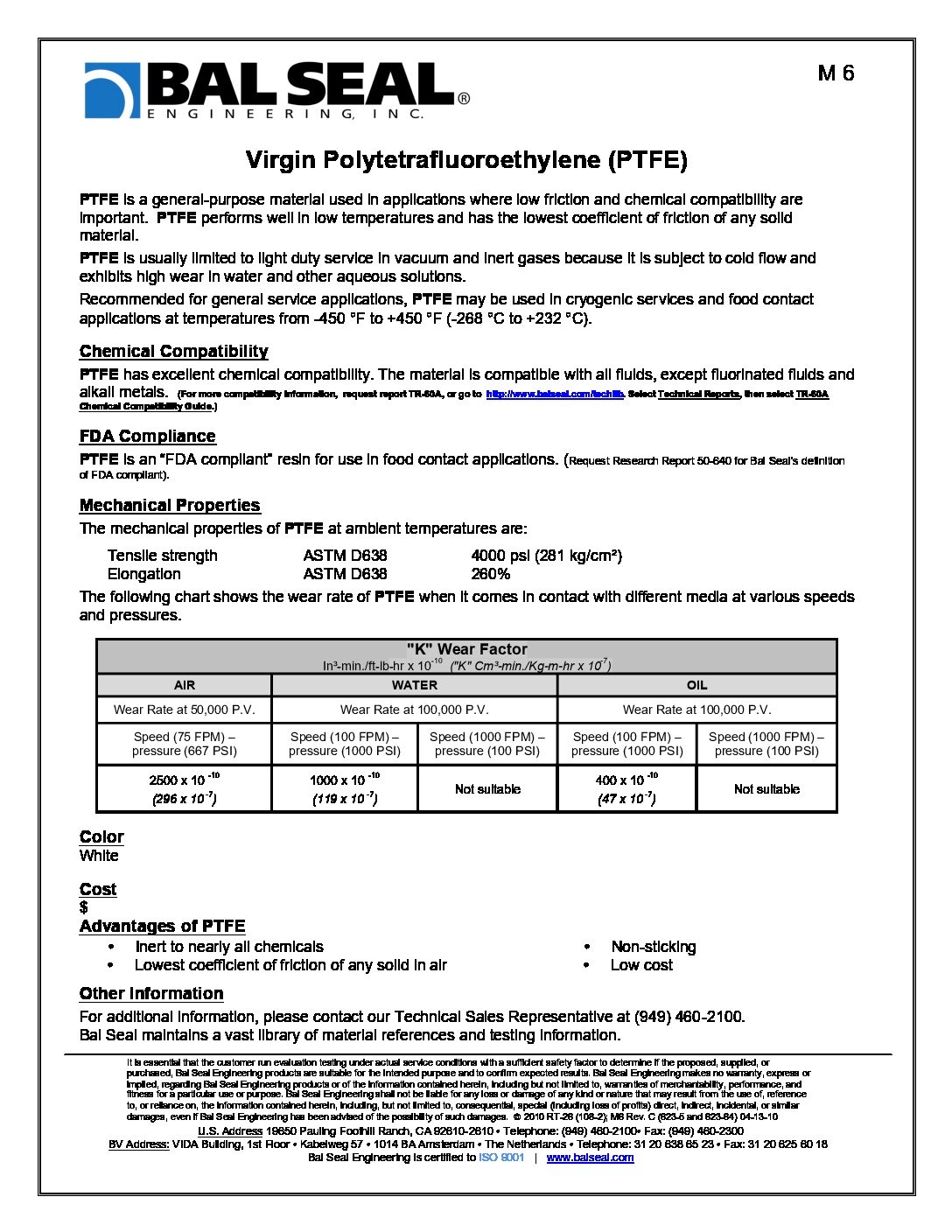
T Virgin PTFE
General-purpose material where low friction and chemical compatibility are important. Usually limited to light-duty service and can be used in vacuum and inert gases. Material is subject to cold flow and exhibits high wear in water/aqueous media. It is compatible with most fluids and gases except molten sodium, etc. Excellent at low temperatures. FDA compliant, compatible, and approved.
|
-450 to 450
(-268 to 232)
|
4,800
(337)
|
400
|
White |
|
T6 PTFE Certified to USP Class VI
PTFE extruded or compressed, certified to USP class VI. This is indemnified. FDA compliance is USP Class VI. FDA approved.
|
-450 to 450
(-268 to 232)
|
4,800
(337)
|
400 | White |
|
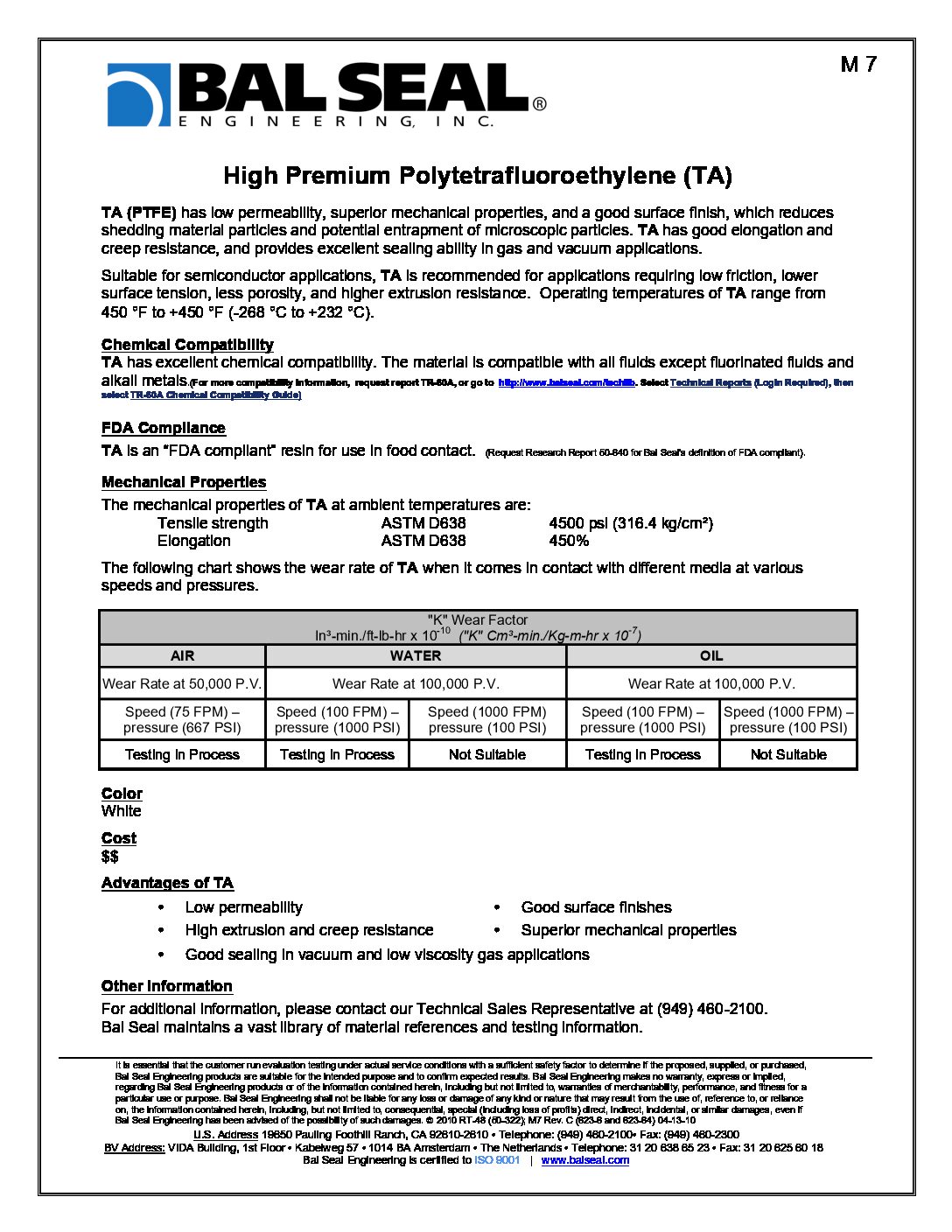
TA PTFE - Low Permeability
Superior mechanical properties with good surface finishes, good sealing ability in gases and vacuum. Suitable for semiconductor applications. FDA compliant and compatible.
|
-450 to 450
(-268 to 232)
|
5,250
(369)
|
570 | White |
| Bal Seal Material | Operating Temperature Range °F (°C) | Tensile Strength at Break psi (kg/cm2 | Elongation at Break (molded direction) % | Color |
|---|---|---|---|---|
|
TFM PTFE
Modified PTFE-TFM fluoropolymer. Not FDA compliant but is FDA compatible.
|
-320 to 500
(-200 to 260)
|
4,800
(337)
|
550 | White |
|
UP30 Filled UHMWPE
Filled polyethylene-UHMW composition polymer in rod/tube/plate form. Not FDA compliant but is FDA compatible.
|
-450 to 180
(-268 to 82)
|
5,500
(387)
|
300 | Yellow-Gold |
|
UP40 UHMW Polyethylene Composition
Filled polyethylene-UHMW composition polymer in rod/tube/plate form. FDA compliant and compatible.
|
-450 to 180
(-268 to 82)
|
5,500
(387)
|
330 | Yellow-Gold |
|
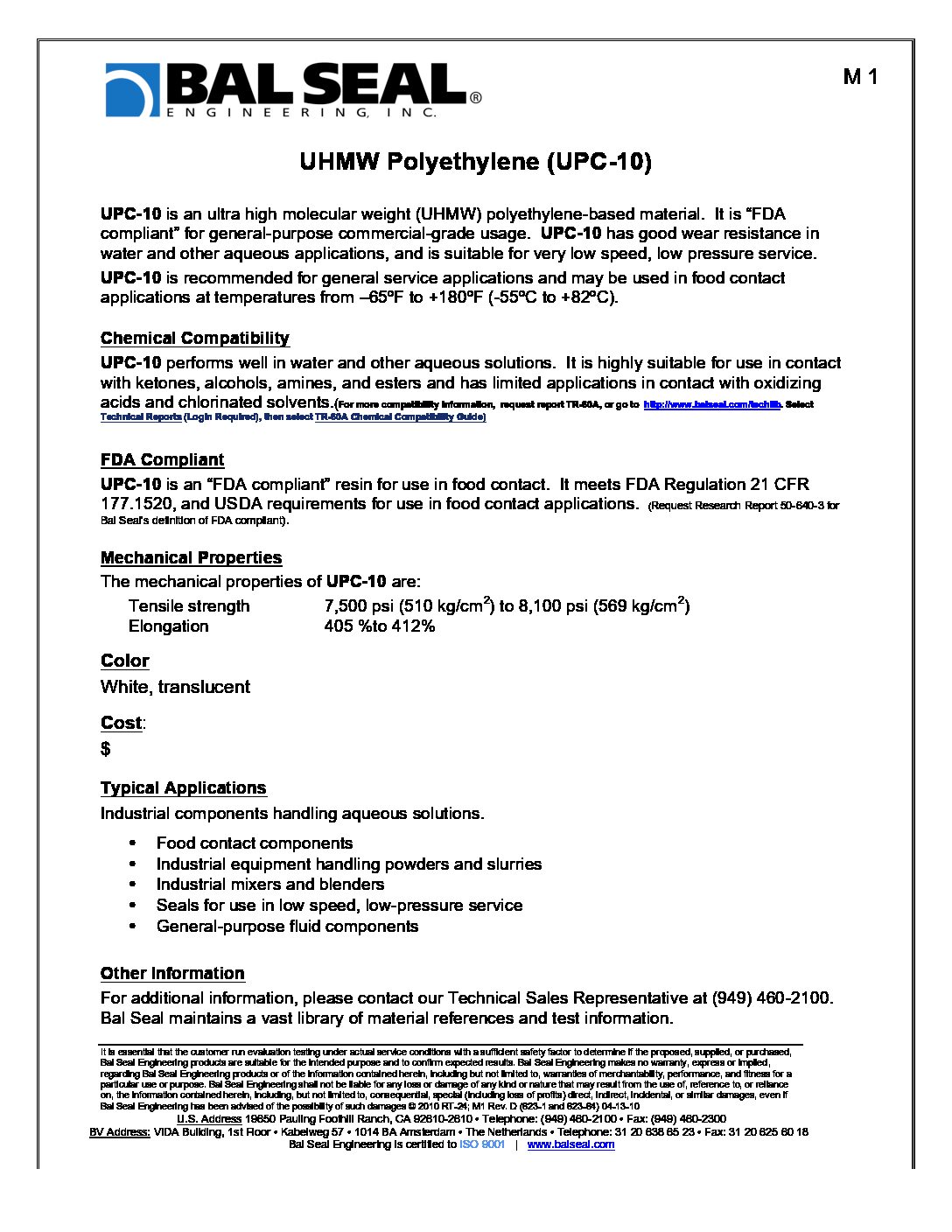
UPC UHMW Polyethylene Composition
Aqueous service. Commercial grade for general-purpose applications. Good wear resistance in water and aqueous solutions. High extrusion resistance but high friction. Limited to temperatures to 180°F (82°C). Suitable for low-speed rotary service. FDA compliant and compatible.
|
-450 to 180
(-268 to 82)
|
7,600
(534)
|
500 | Translucent White |
|
UPC15 UHMWPE Certified to USP Class VI
UHMW-polyethylene for medical applications, implantation-type applications. FDA compliance is USP Class VI.
|
-450 to 180
(-268 to 82)
|
7,900
(555)
|
400
|
White |
|
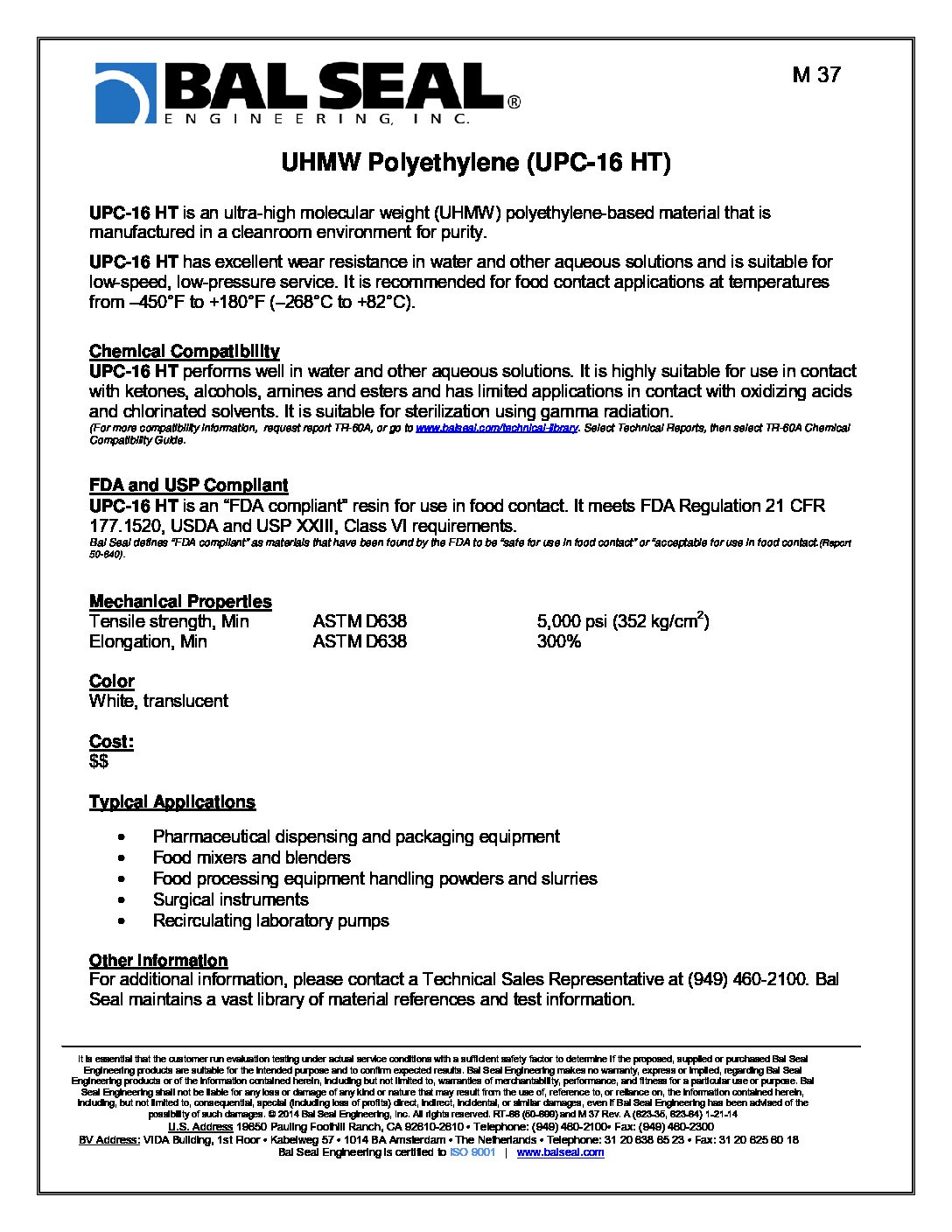
UPC16 Medical Grade, UHMWPE Meets USP Class VI Requirements
UHMW-polyethylene for medical applications, not for implantation-type applications. FDA compliant and compatible.
|
-450 to 180
(-268 to 82)
|
7,500
(527)
|
400 | White |
|
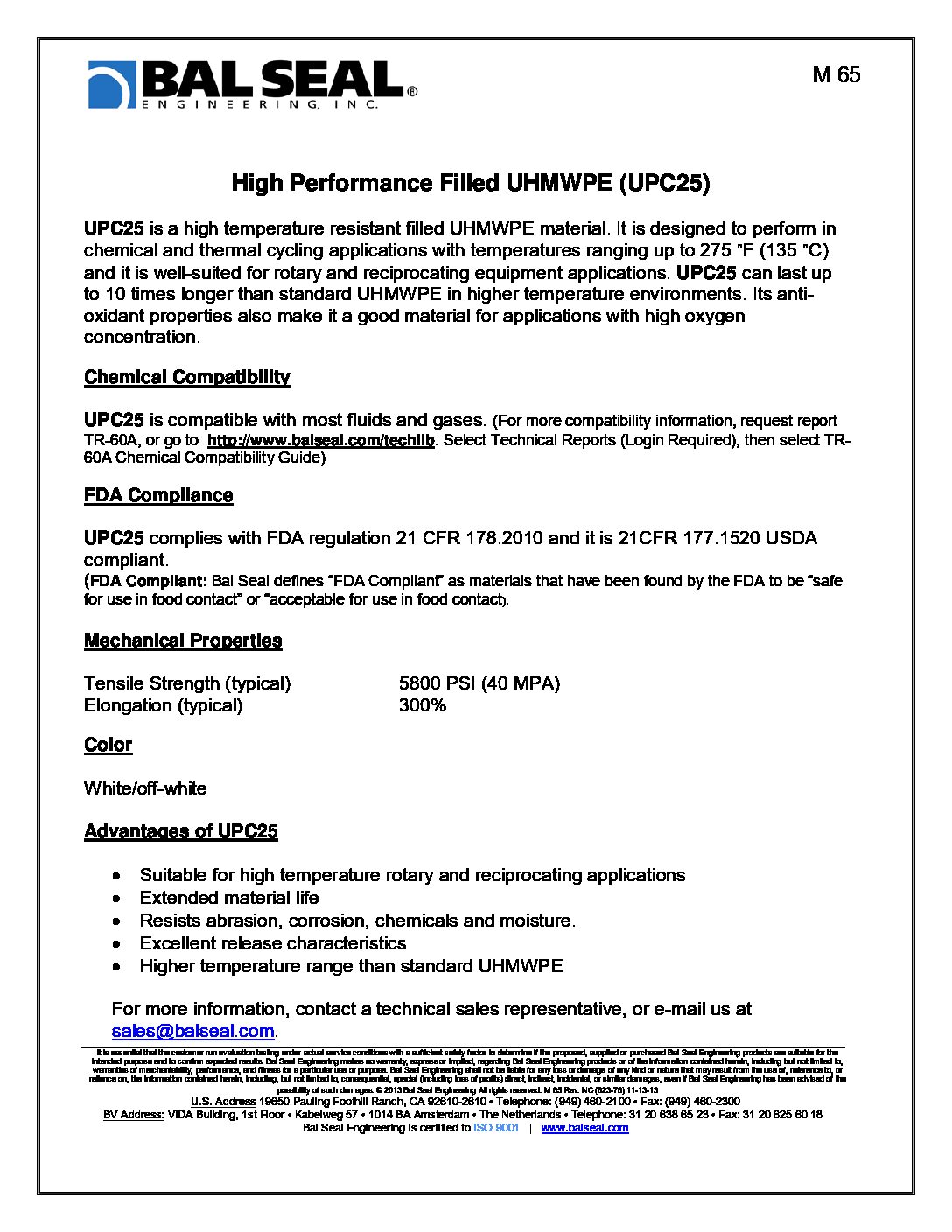
UPC25 High-Temperature UHMWPE
UHMW-polyethylene with additives to improve temperature range above normal UHMWPE. FDA compliant and compatible.
|
to 212
(to 100)
|
5,800
(408)
|
300 | White |
Elongation at Break. The maximum percent elongation that a material sample sustains under load just before it ruptures during a tensile test. Results are shown are typical and at room temperature (70°F, 23°C) unless indicated otherwise.
FDA Approved. Compositions that, as a whole entity, have been approved by the FDA and are listed as approved compositions on FDA's web site.
FDA Compliant. Compositions where 100% of the compositions’ individual ingredients have been designated by FDA to be “safe for use in food contact.” In addition, none of the ingredients are listed on the California Code of Regulations Hazardous Substance list. Note that everything that is FDA approved is automatically FDA compliant.
FDA Compatible. Compositions where the majority (97% or more) of ingredients have been designated by FDA to be “safe for use in food contact.” In addition, none of the ingredients are listed on the California Code of Regulations Hazardous Substance list. Note that everything that is FDA approved is automatically FDA compatible.
Operating Temperature Range. The suggested minimum and maximum limits at which the material would operate effectively. It is important to note that operating temperature range is significantly affected by the operation speed and pressure. As the operating speed and pressure increase, so does the temperature at the contact point, thus reducing the overall operating temperature range.
Tensile Strength at Break. The maximum stress level that the material being stretched can withstand without tearing. Typical results are shown at room temperature (70°F, 23°C) unless indicated otherwise.
It is essential that the customer run evaluation testing under actual service conditions with a sufficient safety factor to determine if the proposed, supplied or purchased Bal Seal Engineering, Inc. products are suitable for the intended purpose and to confirm expected results. Bal Seal Engineering, Inc. shall not be liable for any loss or damage of any kind or nature that may result from the use of, reference to, or reliance on the information contained herein, including but not limited to consequential, special (including loss of profits) direct, indirect, incidental or similar damages, even if Bal Seal Engineering, Inc. has been advised of the possibility of such damages.