The custom-engineered Bal Seal® spring-energized seal sets new standards for performance and reliability in reciprocating applications. Precision machined from PTFE and other premium polymers, our spring-energized seal combines innovative geometries with a wear-regulating canted coil spring energizer to extend the service life of the critical equipment you design.
What Is a Spring-Energized Reciprocating Seal?
A spring-energized reciprocating seal is a precision-machined polymer U-cup seal reinforced with an internal spring element that maintains consistent sealing contact between a piston and a cylinder bore. Unlike standard elastomeric seals and O-rings that rely solely on material compression, spring-energized reciprocating seals use a canted coil spring, helical spring, or cantilever spring to compensate for wear, thermal cycling, and hardware tolerance variations — maintaining sealing pressure for prolonged service life as the piston cycles back and forth.
Bal Seal® reciprocating piston seals are custom engineered from PTFE, PEEK, UHMWPE, and other advanced fluoropolymer and thermoplastic compounds. Each seal is designed for the specific pressure, temperature, speed, and media conditions of your application, providing a reliable sealing solution that outperforms conventional seals.
Model Your Own Reciprocating Seal
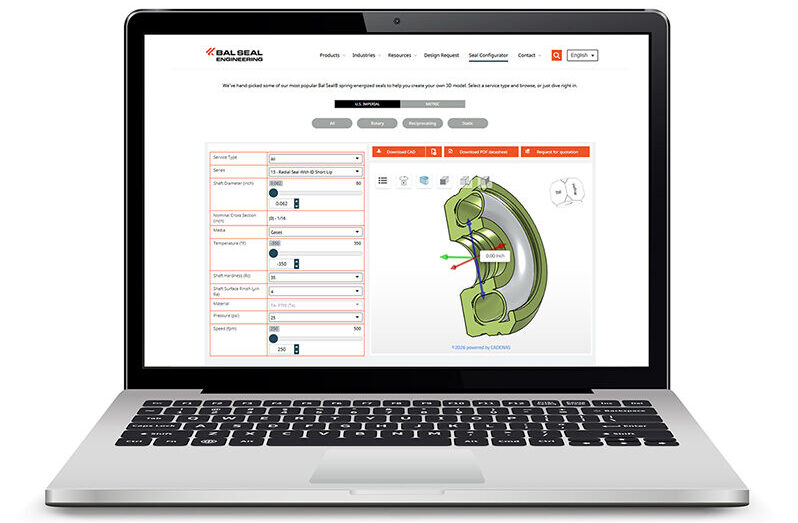
We’ve hand-picked some of our most popular Bal Seal® spring-energized seals to help you create your own 3D model. Select a service type and browse, or just dive right in.
Why Choose a Spring-Energized Reciprocating Seal?
Design engineers across aerospace, medical, oil and gas, industrial equipment, and semiconductor industries choose Bal Seal® spring-energized reciprocating seals when conventional sealing solutions can’t meet the demands of their high-pressure, high-cycle, or chemically aggressive reciprocating applications.
High-Pressure Performance
Bal Seal® reciprocating seals are engineered for pressures exceeding 20,000 PSI. Robust jacket geometries with anti-extrusion heel designs and backup rings maintain seal integrity under extreme pressure differentials, preventing gap extrusion and premature failure in hydraulic and pneumatic systems.
Extended Service Life & Reduced Maintenance
The spring energizer maintains constant sealing force as the seal jacket wears, compensating for material loss, thermal expansion, and hardware tolerance variations. This inhibits the premature formation of progressive leak paths that cause conventional seals to fail, significantly reducing maintenance requirements and increasing equipment uptime.
Broad Chemical & Temperature Compatibility
Advanced PTFE compounds, PEEK, and filled polymer formulations provide resistance to aggressive hydraulic fluids, solvents, gases, and corrosive media across a temperature range from cryogenic conditions to over 600°F. Low-friction seal materials minimize heat generation during high-cycle reciprocating service.
Reciprocating Piston Seal Materials
The Bal Seal® spring-energized reciprocating seal gives you the ability to closely control frictional forces and optimize sealing effectiveness in a broad range of chemicals, temperatures, and pressures. Base jacket materials consist of polytetrafluoroethylene (PTFE), polyethylene (PE), polyetheretherketone (PEEK), and other specialty polymers. We combine these with advanced filler materials to enhance performance properties. Here’s a small sampling of the materials we’ve formulated for specific reciprocating application requirements.

Excellent wear resistance in various gases, Low abrasion to dynamic surfaces and soft mating materials (aluminum, mild steel, brass, plastics), FDA compliant

Light-duty service, Low friction, Very good chemical compatibility, Good wear resistance in liquids, humid conditions

Severe service conditions, Excellent performance in applications with high pressure, low speed, and high temperature

Severe dry and liquid service, Excellent wear and extrusion resistance in liquids, inert gases, and vacuum

Superior heat and wear resistance, Performs well in high or low speed applications when running against soft metals

Ideal for contact with housings made from soft metal or plastic, Performs well in high-speed, low pressure applications

Light-duty service, Low friction, Excellent chemical compatibility, FDA compliant

High purity, High wear resistance in water and aqueous solutions, FDA compliant


Ideal for bearing seals and backup ring applications, Tolerance for high temperatures and pressures, Excellent chemical compatibility
Reciprocating Piston Seal Energizers
At the heart of almost every Bal Seal® reciprocating seal is an energizer that’s precision-engineered to promote even wear and longer seal service life. Choosing the right energizer – with the ideal combination of force, fit, and finish – is as critical to the success of your design as the seal material itself.

Bal Spring®
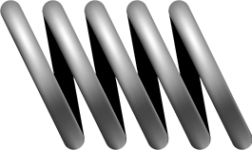
Canted Coil Spring Energizer
Friction: Low
Sealing Force: Low
Bal Spring®
Canted Coil Spring Energizer
Friction: Moderate
Sealing Force: Moderate

Bal Spring®
Canted Coil Spring Energizer
Friction: High
Sealing Force: High

Bal Spring®
Helical Spring Energizer
Friction: High
Sealing Force: High

Bal Spring®
Cantilever Spring Energizer
Friction: High
Sealing Force: High

Elastomeric O-Ring Energizer
Friction: High
Sealing Force: High
Spring Energizer Force
The Bal Spring® canted coil spring exhibits a unique deflection and force behavior when it’s compressed. Unlike typical spring technologies, our spring exerts a near-constant force across the working deflection range, and its forces remain consistent – even in wide temperature ranges. It resists compression set, and its individual coils compensate for misalignment, tolerance variations, and surface irregularities.
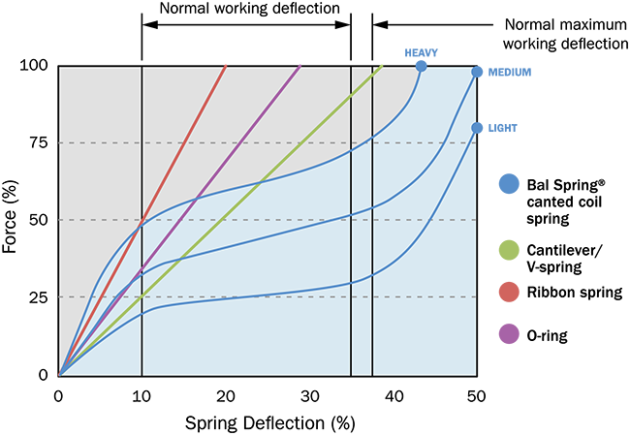
A variety of spring energizer materials are available to meet chemical, temperature, and galvanic compatibility requirements
STAINLESS STEEL (302, 316, 316L) | MP35N® | PLATINUM IRIDIUM | TITANIUM | HASTELLOY® | INCONEL® | BERYLLIUM-COPPER | ZIRCONIUM-COPPER
Reciprocating Piston Seal Sizes
We produce our Bal Seal spring-energized seals for reciprocating applications in sizes ranging from 0.020 in. (.508 mm) to 120 in. (304.8 cm) inside diameter.
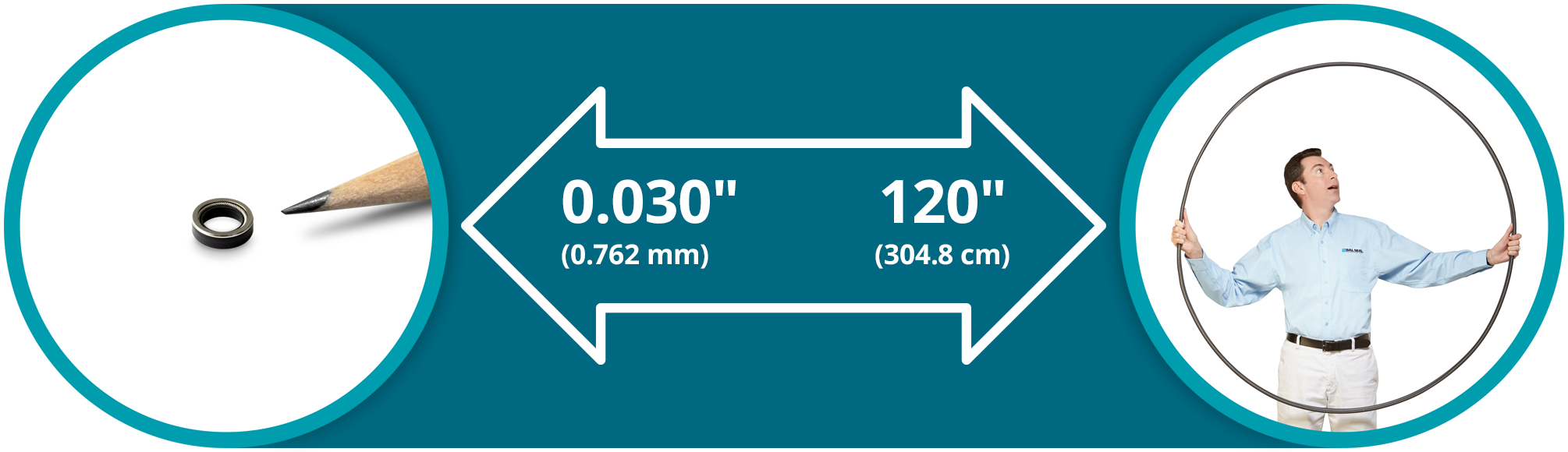
Reciprocating Piston Seal Service Conditions
Temperature, pressure, speed, and media. These are just a few of the major factors you’ll need to consider when choosing a seal for reciprocating applications. Our nearly limitless combination of seal materials, energizers, and geometries – coupled with our consultative engineering approach – will help you address all of them, and create a solution that sets your designs apart. Here’s a look at how our Bal Seal® spring-energized seal performs under a variety of conditions.
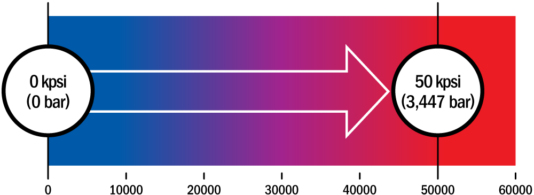
Pressure Resistance
(thousand pounds per square inch)
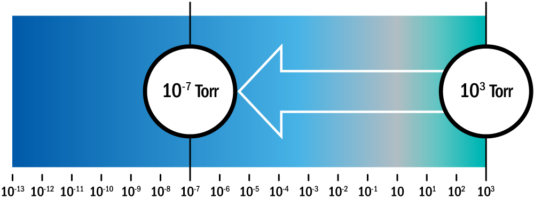
Vacuum Resistance
(Torr)
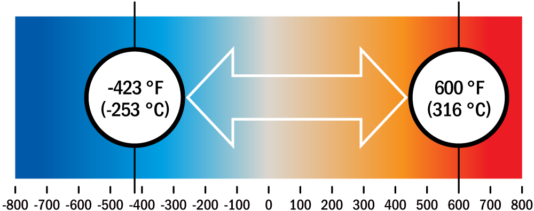
Temperature Resistance
(° fahrenheit)
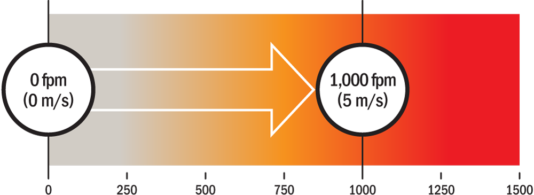
Surface Speed
(feet per minute)
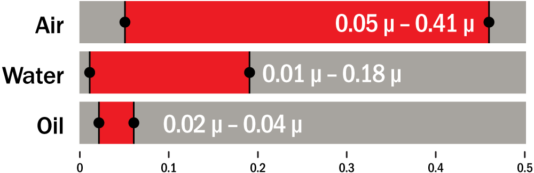
Frictional Values
(at ambient temperature)
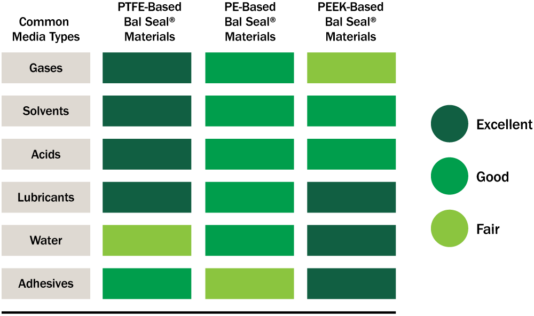
Seal Media Compatibility
Locking & Anti-Extrusion Devices
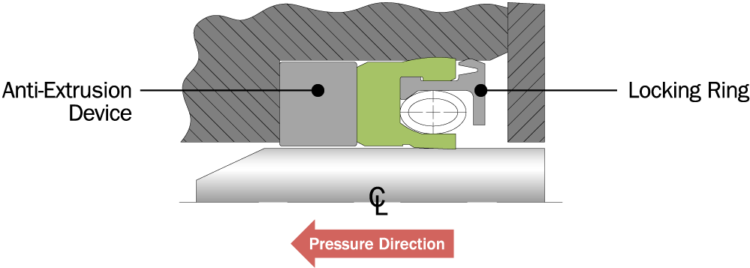
For applications requiring an added level of protection, we can integrate an engineered metal locking ring into the Bal Seal® spring-energized seal design. The locking ring prevents rotation of the seal in the hardware, and it promotes consistent sealing contact under thermal cycling conditions. Backup devices made from PEEK and other materials can be designed to integrate with the seal jacket geometry, or they can be provided as separate parts.
Reciprocating Seal Industry Applications
Bal Seal® custom reciprocating piston seals are engineered for the most demanding linear-motion sealing challenges across critical industries. Our consultative design process ensures each seal is optimized for your specific operating conditions.
Aerospace & Defense
Flight-critical hydraulic actuators, landing gear systems, missile guidance, and environmental control systems demand seals that perform reliably at extreme pressures and temperatures with zero tolerance for leakage.
Medical Devices & Life Sciences
Precision syringe pumps, drug delivery devices, surgical instruments, and diagnostic equipment require reciprocating seals with FDA-compliant materials, ultra-low friction, and minimal particle generation for patient safety.
Oil, Gas & Energy
Downhole tools, hydraulic fracturing equipment, subsea actuators, and high-pressure compressors operate under extreme pressures and aggressive wellbore fluids where our high-pressure, wear-resistant piston seals deliver extended service life.
Semiconductor & Analytical Sciences
Precision dispensing systems, chromatography pumps, mass spectrometry, and wafer processing equipment require chemically inert seals with ultra-clean materials and precise, repeatable reciprocating motion.
Industrial & Fluid Power
Hydraulic cylinders, pneumatic actuators, injection molding machines, and industrial presses benefit from our low-friction PTFE piston seals that reduce stick-slip, minimize breakout force, and extend equipment uptime across millions of cycles.
Food, Beverage & Pharmaceutical
FDA-compliant and USP Class VI materials ensure our reciprocating seals meet stringent purity standards for pharmaceutical filling lines, food processing pistons, and clean-in-place systems where media contamination is unacceptable.
Reciprocating Piston Seal FAQs
A reciprocating seal is designed to maintain a barrier as a piston or rod moves linearly back and forth within a bore, while a rotary seal handles continuous shaft rotation. Reciprocating seals must manage bidirectional pressure, prevent extrusion under high differential pressures, and minimize stick-slip and breakout friction — design challenges that require different seal geometries, lip profiles, and energizer configurations than rotary applications.
Bal Seal® spring-energized reciprocating seals are engineered for pressures exceeding 20,000 PSI (1,379 bar). High-pressure seal designs feature robust jacket geometries with anti-extrusion heel zones and can be paired with PEEK or metal backup rings to prevent gap extrusion at extreme pressure differentials. Seal profile, material selection, and energizer force are all engineered to the specific pressure requirements of your application.
Bal Seal® reciprocating seals are precision machined from advanced polymers including polytetrafluoroethylene (PTFE), polyetheretherketone (PEEK), ultra-high molecular weight polyethylene (UHMWPE), and specialty fluoropolymers. These base materials are combined with graphite, carbon fiber, molybdenum disulfide, glass, and other fillers to optimize wear resistance, extrusion resistance, friction, and chemical compatibility for your specific reciprocating application.
The spring energizer — typically a Bal Spring® canted coil spring — applies near-constant radial force against the sealing lip, compensating for jacket wear, thermal expansion, and hardware tolerances over time. This sustained contact force prevents the progressive formation of leak paths that cause conventional seals to fail. The result is longer service life, more consistent sealing performance, and significantly reduced maintenance intervals compared to standard O-rings or non-energized polymer seals.
Yes. Bal Seal® reciprocating seals are engineered for vacuum environments down to 10⁻⁸ Torr as well as high-pressure service. The spring energizer ensures the seal maintains contact force even at low or negative differential pressures where conventional seals lose their interference fit and begin to leak.
Specifying a reciprocating seal requires defining your operating pressure range, stroke length, cycle rate, temperature range, media compatibility, and hardware dimensions and materials. Bal Seal engineers work directly with your design team through a consultative process to optimize the seal profile, jacket material, filler compound, and energizer type for your exact requirements. Contact our engineering team to begin the design process.
Request Reciprocating Seal Engineering Support
Every Bal Seal® reciprocating piston seal is custom engineered for your specific application. Our seal design experts will evaluate your operating conditions — pressure, temperature, stroke, cycle rate, media, and hardware — and recommend a solution optimized for performance and service life. From single prototypes to high-volume production, our precision seal manufacturing delivers the quality and consistency critical applications demand.
Technical Resources
Product Catalog
Application Bulletin
Technical Report