With the Bal Spring® canted coil spring contact element, you can build custom electrical connectors that manage more power in less space at cooler running temperatures. Our spring’s independent coils, which serve as multiple contact points for optimal conducting or grounding capability in static or dynamic electrical applications, ensure consistent, reliable connection—even under shock and vibration. The Bal Spring effectively manages high, medium, and low current over long periods with minimal heat rise in a compact footprint, making it an ideal choice for designers who want to advance the performance of their equipment while reducing size, weight, and system complexity.
What Is a Spring-Loaded Electrical Contact?
A spring-loaded electrical contact is a conductive element that uses an internal spring to maintain consistent contact force against a mating surface, ensuring reliable current transmission in static and dynamic electrical connections. The Bal Spring® canted coil spring serves as both the contact element and the force-generating mechanism — its multiple independent coils create numerous parallel contact points that distribute current evenly, reduce resistance, and minimize heat rise.
Unlike conventional pin-and-socket connectors, pogo pins, or leaf spring contacts, a canted coil spring contact element delivers near-constant force across its deflection range, compensating for wear, thermal expansion, and tolerance variations over thousands of mating cycles. This makes it an ideal solution for custom electrical connectors in medical devices, aerospace systems, defense electronics, and industrial power applications where connection reliability is critical.
Why Choose Canted Coil Springs for Electrical Connections?
Design engineers choose Bal Spring® canted coil spring contact elements over conventional connector technologies when they need to manage more current in less space, reduce connector size and weight, or improve connection reliability in harsh environments.
Higher Current Density, Lower Heat Rise
The canted coil spring’s multiple independent coils act as parallel contact points, distributing current across a wide surface area. This dramatically reduces resistance and heat generation compared to single-point contact technologies like pogo pins, enabling higher continuous and short-circuit current capacity in a significantly smaller footprint.
Reliable Connection Under Shock & Vibration
Each coil deflects independently to maintain contact through shock loads, vibration, thermal cycling, and to compensate for mating surface irregularities. The spring’s near-constant force profile ensures consistent electrical performance from the first cycle to the ten-thousandth — preventing current and signal integrity loss that can plague conventional contact types.
Multi-Function: Conduct, Connect & Shield
A single Bal Spring® canted coil spring can simultaneously serve as an electrical conductor, a mechanical connector (latching or holding), and an EMI/RFI shield. This multi-function capability reduces component count, simplifies assembly, and shrinks the overall connector envelope — critical advantages in space-constrained medical, aerospace, and defense applications.
Electrical Spring Mounting Configurations
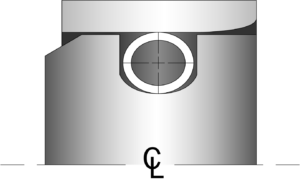
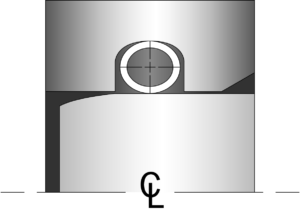
As a contact element, the Bal Spring® canted coil spring is typically used in either housing-mounted or piston-mounted configurations. Designs can employ grooves that are rounded (like the one shown here),or with flat or “V”bottoms. We’ll help you choose which groove design works best for your application.
Electrical Spring Conductive Properties
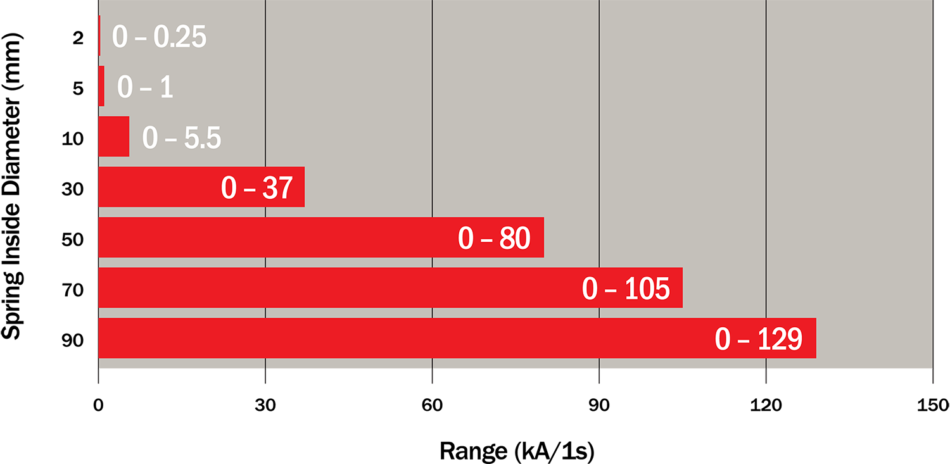
Many design factors, including wire material, wire diameter, coil height, spring force, and plating thickness, contribute to the performance of our Bal Spring® canted coil spring. We can precisely control each of these to engineer a spring that delivers the level of performance you need. Here’s a sampling of some common spring sizes and their basic electrical properties.
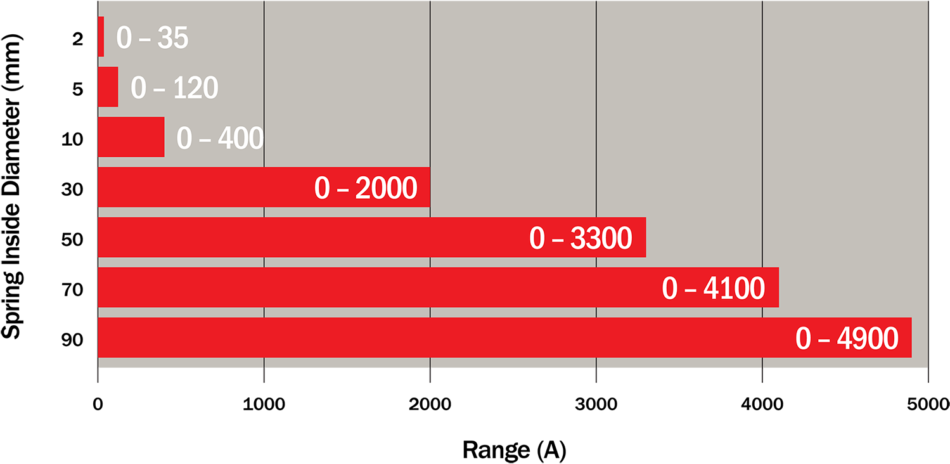
Continuous Current Range by Spring Size
Short Circuit Current Range by Spring Size
This information is based on silver-plated copper alloy material at pre-defined conditions. We offer larger wire diameters with higher capacities than those shown here. *Continuous current range estimate is with H = 25W/m²K @ 40 °C with 65 °C allowable temperature rise.Values presented are calculated estimates. Actual values will vary depending on specific applications.
Electrical Spring Force
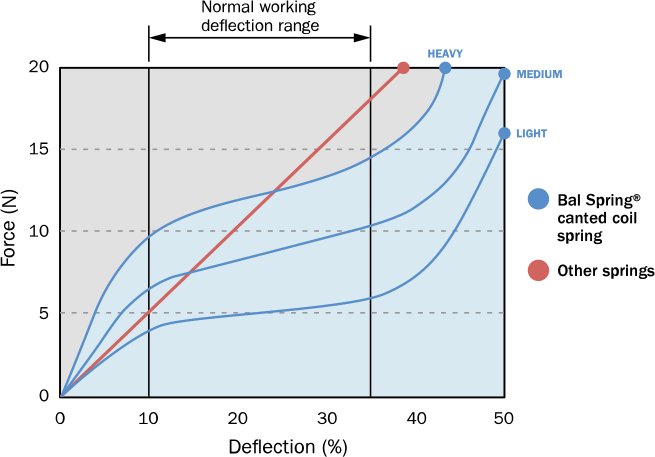
Unlike typical contact element technologies, our Bal Spring canted coil spring exerts a near-constant force across the working deflection range, and its forces remain consistent–even under extreme temperature variations. It resists compression set, and its individual coils compensate for misalignment, tolerance variations, and mating surface irregularities. For applications requiring both electrical conducting and mechanical connecting, we can adjust spring groove, spring size, wire diameter and other characteristics to precisely control the force it takes to latch, lock, hold, connect, and disconnect.

Electrical Spring Materials & Plating
Bal Spring® canted coil spring contact elements are precision-manufactured from premium copper alloy and stainless steel base wire materials, chosen for their excellent combination of mechanical and electrical properties. Our copper alloys are conductive enough to be used unplated in many applications. The performance of our stainless steel materials, which offer a higher force-per-unit compression value than copper in the same spring dimension, can be enhanced by plating with a more conductive metal.
Bal Spring wire materials include:
- STAINLESS STEEL (302, 316, 316L)
- BERYLLIUM-COPPER
- ZIRCONIUM-COPPER
Plating Options Include:
- GOLD
- SILVER
- NICKEL
- TIN
Plating can make the Bal Spring more efficient in humid or corrosive environments, or in any application that calls for higher conductivity. We can supply springs plated to MIL standards or other specifications. While silver is usually the first choice for high conductivity requirements, it’s also important to consider corrosion and potential wear characteristics. We apply protective coatings to our silver-plated Bal Spring contact elements for an added level of corrosion resistance.
Electrical Spring Sizes
Our Bal Spring canted coil springs are available in non-welded lengths of various sizes (for simple or complex groove configurations), and welded rings from 0.020” (.51 mm) ID. Since every spring is designed to meet the unique requirements of your application, we don’t stock a “standard” size and type. But we do maintain a database of commonly-requested diameters and cross-sections, which can serve as a baseline for streamlined customization.
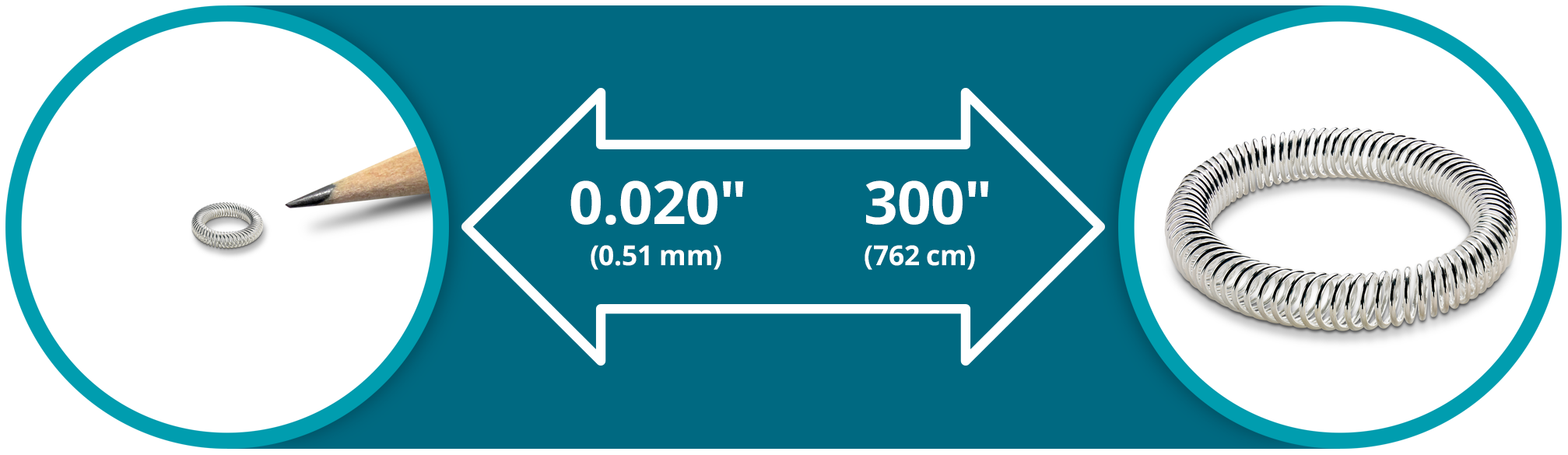
This chart is provided solely as an illustration of common spring dimensions. Spring properties, including wire diameter, wire material, coil width, coil height, coil cant angle, spring ID/OD, and plating can be precisely customized for optimal performance.
Electrical Spring Orientation
Our Bal Spring® canted coil spring can be designed with coils that deflect in an axial or radial orientation. This makes it possible to optimize the direction of the force in your design, ensuring effective, long-term service. For housing or piston mounted designs, a radial spring orientation is typically recommended. Axial springs are often specified for face mounted installations.
Radial Spring
Compression force of a radial canted coil spring is along the radius of the arc or ring, perpendicular to the centerline.

Axial Spring
Compression force of an axial canted coil spring is along the axis of the arc or ring, parallel to the centerline.

Service conditions, spring configuration (length or ring), and other factors can influence this design choice. Our engineers will help you to determine which spring orientation delivers the best performance.
One Component, Three Functions
Some designers use the Bal Spring® canted coil spring to mechanically latch, lock, or hold critical machine components. Some use it to shield against EMI/RFI. Others leverage our spring’s ability to electrically conduct and ground. However you choose to use it, you’ll increase performance, improve reliability, and gain a competitive edge.
Electrical Spring Industry Applications
Bal Spring® canted coil spring contact elements are engineered into critical systems where reliable current transmission, compact size, and long cycle life are essential.
Medical Device Power & Signal Springs
Surgical handpiece power springs, patient monitoring lead springs, implantable device charging springs, and diagnostic instrument interface springs require biocompatible, sterilizable spring contact solutions with consistent contact resistance across thousands of mating cycles.
Aerospace & Defense Electronics
Avionics power distribution, satellite bus electrical systems, weapons systems, and ruggedized communications equipment demand electrical spring contacts that maintain low-resistance electrical paths under extreme shock, vibration, temperature cycling, and altitude conditions where failure is not an option.
Power & Energy Systems
Switchgear electrical contacts, busbar power springs, power substation grounding, and renewable energy system interfaces benefit from the canted coil spring’s ability to handle high continuous current with minimal heat rise, reducing thermal management requirements and improving system efficiency.
Industrial & Automation
Robotic tool changer power springs, slip ring alternatives, motor brush replacements, and automated test equipment require electrical spring contacts that deliver consistent conductivity and mechanical retention across millions of cycles in high-throughput production environments.
Test & Measurement
Burn-in sockets, IC test springs, PCB test fixture springs, and probe card interface springs require spring contacts with precise force control, low contact resistance, and minimal resistance variation — ensuring accurate, repeatable measurements across high-volume test cycles.
EMI Shielding & Grounding
Enclosure grounding springs, EMI gasket replacements, shielded interface springs, and rack-mount equipment grounding applications leverage the canted coil spring’s 360-degree contact and low impedance path to provide effective electromagnetic shielding across a broad frequency range.
Electrical Conducting Spring FAQs
An electrical contact is the conductive element that physically touches a mating surface to transmit current. An electrical connector is the complete assembly that houses one or more contacts and provides the mechanical interface for mating and unmating. Bal Seal manufactures spring-loaded electrical contacts using canted coil spring technology. These contacts can be integrated into custom connector assemblies — including SYGNUS® connectors — or used as standalone contact elements within your own connector housing designs.
Current capacity depends on wire material, wire diameter, plating, and thermal management conditions. Bal Spring® canted coil spring contacts are available in a range of sizes that support continuous current from milliamps to over 100 amps, with short-circuit ratings significantly higher. Silver-plated copper alloy springs offer the highest conductivity, while stainless steel springs provide higher mechanical force per unit compression. Our engineers will size the spring to meet your specific current and temperature rise requirements.
Bal Spring® electrical conducting springs are manufactured from beryllium-copper and zirconium-copper base wire materials for maximum conductivity, or from stainless steel (302, 316, 316L) when higher mechanical force is needed. Springs can be plated with gold, silver, nickel, or tin to enhance conductivity, improve corrosion resistance, or meet galvanic compatibility requirements. Plating can be applied to MIL specifications or other industry standards.
Unlike pogo pins that rely on a single contact point, a canted coil spring provides multiple parallel contact points across its circumference. This distributes current more evenly, produces lower contact resistance, generates less heat, and maintains more consistent force over the deflection range. Canted coil springs also tolerate greater misalignment, compensate for tolerance variations, and resist the sticking and debris sensitivity issues common with pogo pin designs. The result is a more reliable, longer-lasting electrical connection.
Yes. The Bal Spring® canted coil spring can simultaneously serve as an electrical conductor, a mechanical connector, and an EMI/RFI shield. The spring’s 360-degree contact provides a continuous, low-impedance path for both signal/power conduction and electromagnetic shielding. This multi-function capability allows designers to replace separate conducting, fastening, and shielding components with a single spring element.
Start by defining your current requirements (continuous and peak), voltage, allowable temperature rise, mating geometry, cycle life, and environmental conditions (temperature range, humidity, vibration, chemical exposure). Bal Seal engineers will work with your design team to select the optimal wire material, plating, spring size, and mounting configuration for your application. Contact our engineering team to begin the design process.
Request Electrical Spring Engineering Support
Every Bal Spring® electrical conducting spring and custom connector solution is engineered for your specific current, force, and environmental requirements. Our spring contact engineers will evaluate your application and design a canted coil spring contact element optimized for conductivity, reliability, and service life. From concept through prototyping and production, our precision spring manufacturing delivers the performance critical electrical connections demand.
Technical Resources
Product Catalog
Application Bulletin

Technical Report