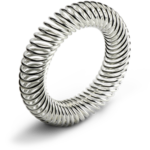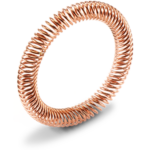
Bal Seal Engineering’s canted coil spring is a multi-purpose component coiled from metal wire and often plated with a variety of metals. Widely known for its use as an energizing element in fluid seals, the spring has mechanical and electrical properties that enable it to mate parts, manage current, protect electronics from electromagnetic interference (EMI), and provide thermal management with superior heat dissipation capabilities. If simple, lightweight, power-efficient designs are your goal, a canted coil spring may be worth considering.
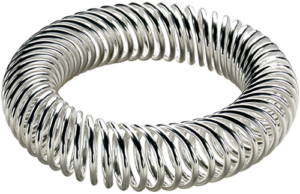
What does a canted coil spring do?
- Mechanically connects
- Conducts electrical current in high shock/vibration
- Shields against EMI/RFI
- Centers/aligns parts
- Manages thermal dissipation
Canted Coil Spring Advantages
Since it generates a near constant spring force vs. deflection range, the canted coil spring can often deliver longer service life than similar components. As hardware surfaces wear, the spring’s individual coils deflect independently to compensate for angular misalignment and hardware surface irregularities. This translates to more reliable conductivity in electrical applications, and higher cycle counts in mechanical applications.
The spring also reduces contamination by incorporating chemically compatible, wear-resistant wire base materials and platings. This lessens the possibility of premature degradation, and minimizes the potential for shedding.
Mechanical Fastening Advantages
As a mechanical fastening component, the canted coil spring latches, locks, and holds. With precise adjustments to the angle of its coils, insertion and removal forces can be controlled from less than 1 lb to 10,000+ lb.
Unlike ball detents, snap rings, molded c-clamps, quick connects, o-rings and other fastener types, the canted coil spring resists fatigue and compression set, so it can maintain consistent, repeatable forces over thousands of cycles.
Electrical Conducting Advantages
In electrical conducting and EMI/RFI shielding applications, the spring’s individual coils provide multi-point contact, and they compensate for mating surface irregularities and misalignment.
As an electrical contact component, the canted coil spring has a high degree of power density; it can manage more current in less space than similar technologies, while minimizing heat rise. The spring’s thermal management capabilities and superior heat dissipation make it ideal for high-current applications where temperature control is critical.
Canted Coil Spring Design
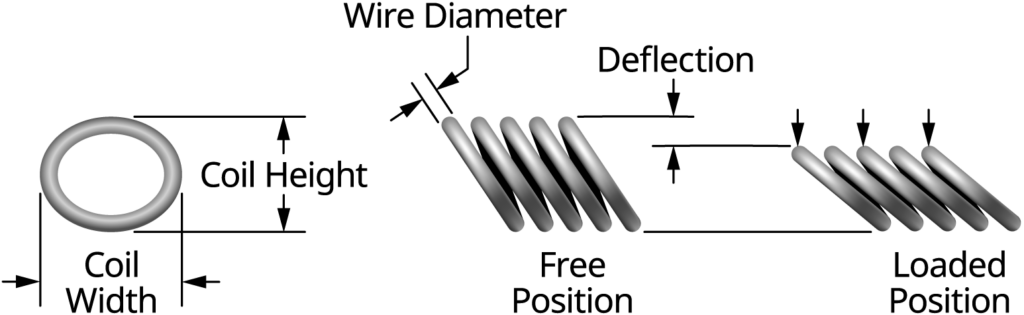
The most visible difference between a canted coil spring and other spring types is its cross-section, which is elliptical or oval, not circular. Key design characteristics of the spring are its wire diameter (WD), coil height (CH), coil width (CW), coil spacing, and coil angle. Each of these can be precisely adjusted to influence force, electrical contact resistance, and other properties.
The orientation of a spring’s coils in relation to the centerline determines whether it is axial or radial. Compression force for a radial canted coil spring is along the radius of the arc or ring, perpendicular to the centerline. Compression force for an axial canted coil spring is along the axis of the arc or ring, parallel to the centerline.
Radial Spring
Compression force for a radial canted coil spring is along the radius of the arc or ring, perpendicular to the centerline.
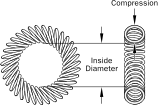
Axial Spring
Compression force for an axial canted coil spring is along the axis of the arc or ring, parallel to the centerline.
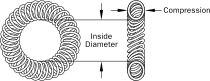
Radial Spring Deflection
How Canted Coil Springs Work
Force-Deflection Behavior
Once installed into a groove—a state known as initial spring force deflection—a canted coil spring’s load remains relatively constant up to maximum deflection. This is the point at which the individual coils touch and no further deflection is possible.
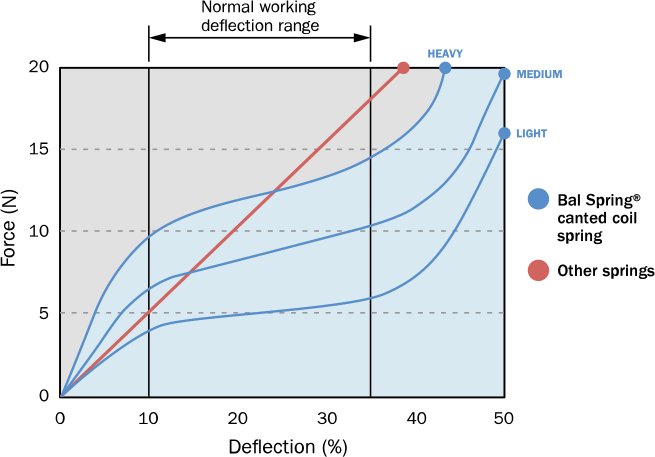
The spring force acting on the contact surfaces remains within the working spring force deflection range while providing only the required force to affect mechanical retention or electrical conductivity. Other components, such as O-rings and V-springs, develop higher initial forces, which are proportional to deflection. This results in higher insertion/breakaway forces, and reduced cycle life.
Electrical Performance Factors
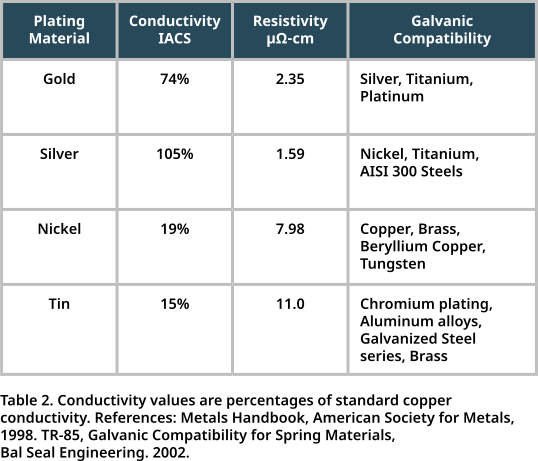
In addition to physical/mechanical forces, design of a canted coil spring used in electrical conducting, EMI shielding, and grounding applications must give special consideration to wire material, plating material, and plating thickness. Plating, the application of highly conductive material over the base wire metal, significantly increases the electrical performance of the spring.
Installation & Groove Design
The canted coil spring is often used in a housing-mounted configuration, but it can also be mounted on a piston or shaft.
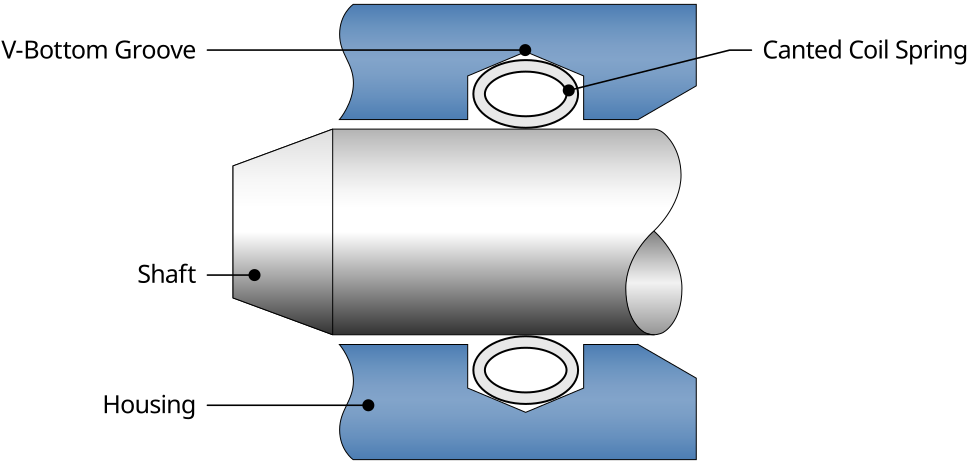
Typical Canted Coil Spring-In-Housing Configuration
Groove Design Considerations
Groove geometry directly impacts spring performance in both mechanical and electrical applications. Common groove profiles include:
- flat bottom (for consistent radial deflection)
- rounded (to accommodate misalignments)
- tapered (for directional latching)
- V-bottom (for maximum EMI shielding effectiveness)
The optimal groove geometry depends on whether the application prioritizes electrical conductivity, mechanical retention force, or both.
Spring Mounting Configurations
Canted coil springs can be installed in three primary mounting configurations:
- Housing-mounted (radial): Spring sits in groove machined into housing bore, most common for rotary seals and electrical connectors
- Piston-mounted (radial): Spring installed on outer diameter of piston/shaft, common in reciprocating applications
Face-mounted (axial): Spring deflects axially between parallel faces, used for EMI shielding gaskets and grounding
Canted Coil Spring Configurations
Welded Rings
The canted coil spring is most widely recognized in its welded ring configuration. This form offers specific advantages for rotary and reciprocating applications. Welded rings provide consistent circumferential force distribution, simplified installation in circular grooves, reliable retention without additional fasteners, and predictable performance in dynamic sealing applications.
Welded rings are available from 0.030″ (0.76mm) inner diameter and larger, with custom dimensions engineered to meet specific application requirements.
Spring Lengths
Canted coil springs are also commonly available in unwelded lengths. These are especially well-suited for EMI shielding applications that require linear installation in simple or intricate patterns. Spring lengths can be plated with silver, gold, and other highly conductive metals to enhance electrical performance.
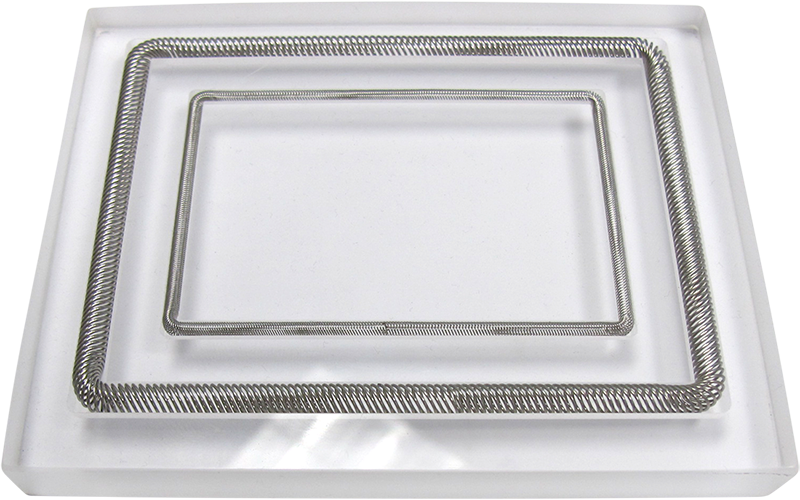
In some applications, the canted coil spring length offers better shielding performance than conductive elastomers, fabrics, foams, and mesh, because its coils resist compression set and maintain consistent, multi-point contact in shock and vibration.
Spring lengths provide design flexibility for complex groove geometries, linear EMI shielding applications, custom path routing in electronic enclosures, and self-retaining or fastener-secured installations.
Materials & Specifications
Wire Materials
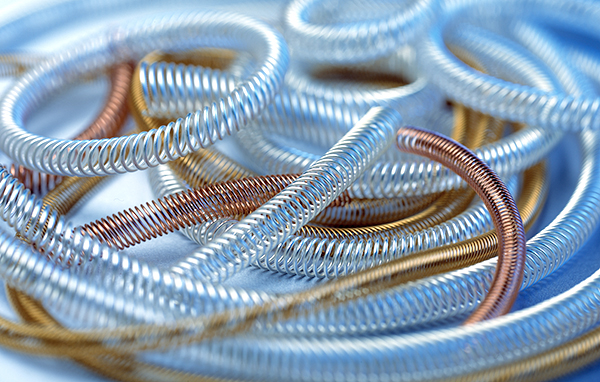
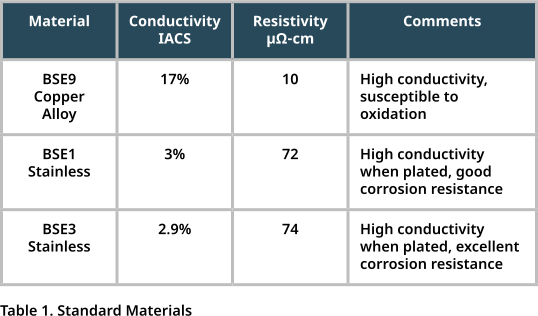
Media resistance, galvanic compatibility—even biocompatibility—can be key factors impacting the selection of canted coil spring wire materials. Copper alloy and stainless steel are popular base wire materials because they combine good electrical and mechanical properties, and they’re relatively easy to source and manufacture.
Copper alloy is conductive enough to be used on its own (unplated) in many applications, but stainless steel may require plating for applications where a higher level of electrical performance is desired. Mechanically, a canted coil spring made from stainless steel wire will have a higher force-per-unit compression than one made from copper alloy.
Available Wire Materials:
- Stainless Steel – (300 Series, 17-7 PH, Custom 455)
- MP35N® – Nickel-cobalt-chromium-molybdenum alloy
- Elgiloy® – Cobalt-chromium-nickel alloy
- Platinum Iridium – Biocompatible precious metal alloy
- Titanium – Lightweight, corrosion-resistant
- Hastelloy® – Nickel-molybdenum-chromium alloy
- Inconel® – Nickel-chromium alloy
- Beryllium-Copper – High conductivity copper alloy
- Zirconium-Copper – Corrosion-resistant copper alloy
Plating Options
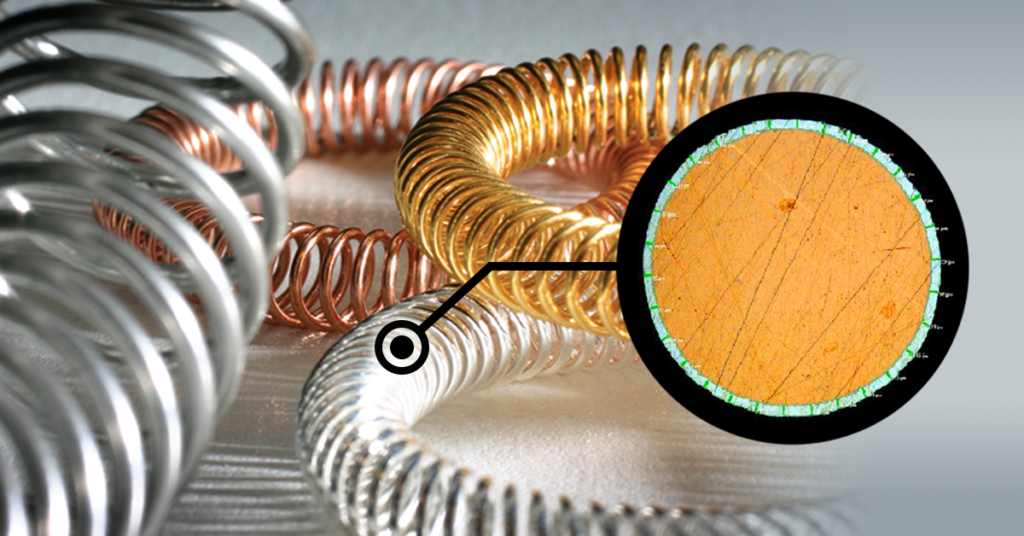
For applications that require higher levels of electrical conductivity, wear prevention, and/or corrosion resistance, a canted coil spring may be plated. In this process, the spring’s base wire material is coated with a thin layer of another, typically more conductive metal. This improves electrical performance while allowing for the use of base wire materials that meet mechanical requirements, such as interface and retention force, temperature resistance, and fatigue resistance, among others. Plated wire significantly outperforms non-plated wire in environments with wide temperature fluctuations and chemically aggressive media.
Different spring plating types are chosen based on their conductivity, material compatibility, galvanic compatibility, and other properties. Plating is usually applied to the entire spring, so that there are no areas of exposed base material. Optimum plating thickness varies by application, with some requiring >5 µm and others up to 20 µm.
Common Plating Materials:
- Gold – Maximum conductivity and corrosion resistance
- Silver – High conductivity, cost-effective
- Nickel – Wear resistance and moderate conductivity
- Tin – Solder compatibility and corrosion protection
Multi-Function Capabilities
The mechanical and electrical capabilities of the canted coil spring are not exclusive. For example, the spring can be used to mechanically latch machine components and protect internal electronics from EMI/RFI. It can also be used to lock parts together while providing an electrical ground. The spring’s ability to perform as many as three functions at once can support lighter designs that are easier to maintain.
Primary Service Types



Canted Coil Spring Applications
A canted coil spring can be an ideal choice for operating environments with strict size restrictions, challenging electrical requirements, wide temperature fluctuations, and aggressive media. It can support design simplification and lightweighting, improve power efficiency, and increase equipment uptime in a wide range of industries and applications.
Industry Applications
for cardiac rhythm management
• Neuromodulation device contacts and
retention mechanisms
• Power connectors for surgical tools, monitors,
and diagnostic equipment
• Orthopedic implant device component retention
• EMI/RFI shielding gaskets for electronic enclosures
• Quick-disconnect couplings for field maintenance
• High-reliability power distribution connectors
• Satellite waveguide quick-connecting and EMI shielding
• Renewable energy system connectors (wind, solar)
• Process control instrumentation contacts
• High and medium-voltage switchgear connections
• Downhole tool connectors for oil and gas drilling (forces >10,000 lb)
• Battery management system contacts
• Sensor retention and alignment systems
• Manufacturing automation connectors
• Material handling equipment contacts


Frequently Asked Questions
Canted coil springs serve three primary functions: mechanical fastening (latching, locking, holding), electrical conducting (current management, grounding), and EMI/RFI shielding. Common applications include defense communications gear, powered surgical tools, and power substation equipment.
The canted coil spring has an elliptical (oval) cross-section rather than circular, and its coils are oriented at an angle to the spring’s centerline. This unique geometry creates a near-constant force across the deflection range, unlike conventional springs where force increases linearly with compression. The spring’s individual coils deflect independently to compensate for wear, misalignment, and tolerance variations, resulting in longer service life and more reliable performance.
Yes. Every Bal Spring® canted coil spring is engineered to meet specific application requirements. Customizable parameters include wire diameter, coil height and width, coil spacing, cant angle, inner and outer diameter, wire material, and plating type and thickness. Springs are available as welded rings (from 0.030″ / 0.76mm ID and larger) or as lengths for custom groove configurations.
Base wire materials include stainless steel, MP35N®, Elgiloy®, platinum iridium, titanium, Hastelloy®, Inconel®, beryllium-copper, and zirconium-copper. Material selection depends on factors including mechanical strength requirements, electrical conductivity, corrosion resistance, temperature range, and biocompatibility. Plating options include gold, silver, nickel, and tin, with thickness ranging from >5 µm to 20 µm depending on application requirements.
Once installed into a groove (initial spring force deflection state), the canted coil spring’s individual coils deflect to create contact pressure. Unlike O-rings or conventional springs that increase force proportionally with deflection, the canted coil spring maintains near-constant force across its working range until maximum deflection—the point where coils touch. This constant-force characteristic reduces insertion force, extends service life through minimized wear, and provides consistent electrical contact resistance throughout the spring’s service life.
Groove design significantly impacts spring performance. Flat bottom grooves provide uniform radial deflection for electrical applications. Rounded grooves accommodate misalignment and tolerance variations. Tapered grooves create directional resistance for latching functions. V-bottom grooves concentrate contact forces for maximum EMI shielding effectiveness. The optimal groove geometry depends on whether the application prioritizes electrical conductivity, mechanical retention force, or both.
Choose Your Application Type
Whether it’s more repeatable, consistent fastening, cooler conducting, better protection against EMI, or a combination of all three, the canted coil spring can offer many advantages over similar components. To learn how our Bal Spring® canted coil spring can help you meet your engineering challenges, select an application type below.