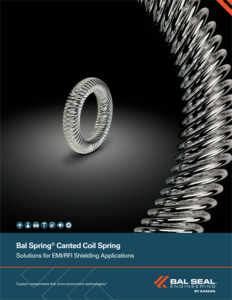
With the Bal Spring® canted coil spring, you can protect sensitive electronics in your designs from the harmful effects of conducted or radiated electromagnetic interference (EMI) and radio frequency interference (RFI). Our spring’s independent coils, which serve as multiple contact points for optimal conductivity in shielding applications, ensure consistent, reliable contact—even under shock and vibration. The Bal Spring provides superior attenuation across a broad EMI spectrum, but it’s particularly effective in high-frequency, small-package applications. It’s the ideal choice for designers who want to advance the performance of their equipment while reducing size, weight, and system complexity.
What Is an EMI Shielding Spring?
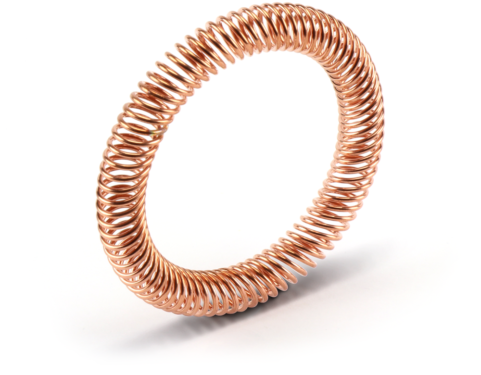
An EMI shielding spring is a precision-engineered canted coil spring – in a welded ring or length of spring configuration – that creates a continuous, low-impedance conductive path between mating surfaces to attenuate electromagnetic interference (EMI) and radio frequency interference (RFI). Unlike conventional EMI gaskets, conductive elastomers, or fingerstock, a canted coil spring resist compression set, degradation, and debris generation.
The Bal Spring® EMI shielding spring’s individual coils serve as multiple parallel contact points, providing 360-degree shielding coverage with near-constant contact force across the working deflection range. This ensures reliable attenuation from 100 MHz through 16 GHz and beyond — making it particularly effective in high-frequency, compact electronic assemblies.
Why Choose Canted Coil Springs for EMI Shielding?
Design engineers choose Bal Spring® canted coil springs over traditional EMI gaskets and fingerstock when they need consistent shielding performance, long service life, and multi-function capability in a compact, lightweight package.
Superior High-Frequency Attenuation
Third-party testing to IEC 61726 demonstrates that the Bal Spring® canted coil spring delivers shielding effectiveness that closely tracks the noise floor from 100 MHz through 16 GHz. Its low transfer impedance outperforms conductive elastomers, knitted wire mesh gaskets, and fingerstock contacts — particularly at the high frequencies critical to modern wireless, radar, and 5G communications systems.
Resists Compression Set & Shedding
Traditional EMI gaskets can lose shielding effectiveness as they take a compression set. Conductive elastomers and other materials can also degrade, resulting in “shedding,” and the contamination of sensitive electronics. The Bal Spring’s metallic construction resists compression set entirely, and its independent coils promote consistent contact for more reliable shielding and less maintenance.
Multi-Function: Shield, Conduct & Connect
A single Bal Spring® canted coil spring can simultaneously provide EMI/RFI shielding, electrical grounding or current conduction, and mechanical latching or holding. This multi-function capability eliminates the need for separate gaskets, ground straps, and fasteners — reducing component count, assembly time, system weight, and overall design complexity.
EMI Shielding Spring Mounting Configurations
For EMI/RFI shielding applications, The Bal Spring®canted coil spring can be supplied in welded rings or lengths. Rings are typically installed in either housing-mounted or piston-mounted configurations . Spring lengths can be engineered to self-retain, or used with other fastening technologies. The Bal Spring can be paired with a variety of groove shapes to optimize shielding effectiveness. Here are some examples.
Rectangular Groove
Easiest to machine
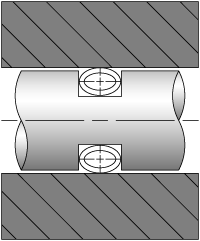
Rectangular Piston
Piston Mounted Welded Ring Spring in Rectangular Groove
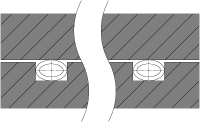
Rectangular Plate
Length of Spring in a Plate Rectangular Groove
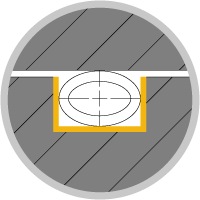
Groove Detail View
Dovetail Groove
Best for retaining spring
in place
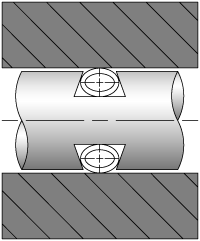
Dovetail Piston
Piston Mounted Welded Ring Spring in Dovetail Groove
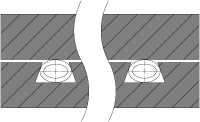
Dovetail Plate
Length of Spring in a Plate
Dovetail Groove

Groove Detail View
Tapered Groove
Best control of forces
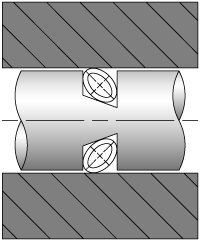
Tapered Piston
Piston Mounted Welded Ring Spring in Tapered Groove
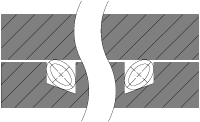
Tapered Plate
Length of Spring in a Plate
Tapered Groove

Groove Detail View
V Groove
Best conductivity
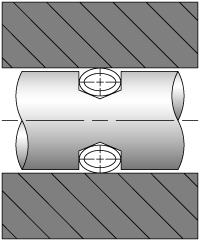
V Piston
Piston Mounted Welded Ring Spring in V Groove
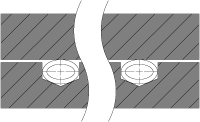
V Plate
Length of spring in a Plate
V Groove

Groove Detail View
EMI Shielding Spring Performance
Unlike typical EMI shielding technologies, our Bal Spring canted coil spring exerts a near-constant force across the working deflection range, and its force remains consistent–even under extreme temperature variations. It resists compression set, and its individual coils compensate for misalignment, tolerance variations, and mating surface irregularities. For applications requiring both shielding and mechanical connecting, we can adjust spring groove, spring size, wire diameter and other characteristics to precisely control the force it takes to latch, lock, hold, connect, and disconnect.
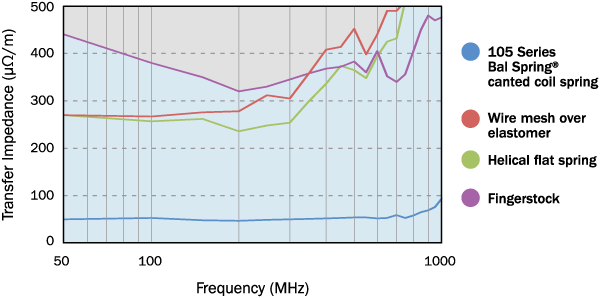
Transfer Impedance of Canted Coil Spring
vs. Other Shielding Methods
And here’s a look at how our spring performs in a range of frequencies.
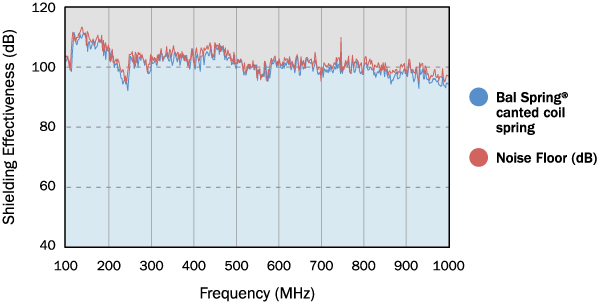
100 MHz-1 GHz
Shielding Effectiveness vs. Frequency
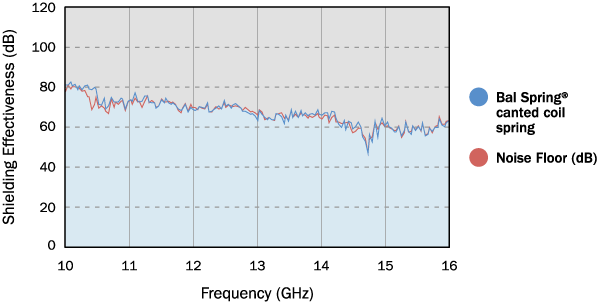
10-16 GHz
Shielding Effectiveness vs. Frequency
These graphs illustrate the Bal Spring’s shielding effectiveness at frequency ranges from 100 MHz-1 GHz and 10-16 GHz. Each graph includes the noise floor for comparison, showing how closely the Bal Spring matches the noise floor throughout the entire frequency range. Tests were performed by an accredited third party following IEC 61726 Standard, using a 50-Ω characteristic impedance coaxial connector with an overall diameter of 0.725. Note: Shielding effectiveness is highly dependent upon connector design and configuration.
EMI Shielding Spring Force
Many design factors, including wire material, wire diameter, coil height, spring force, and plating thickness, contribute to the performance of our Bal Spring® canted coil spring. We can precisely control each of these to engineer a spring that delivers the level of shielding you need. Here’s a look at how the Bal Spring stacks up to other shielding technologies.
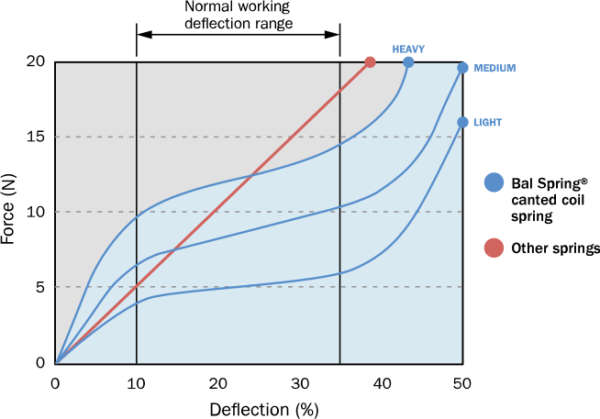

EMI Shielding Spring Materials & Plating
Bal Spring® canted coil springs for EMI shielding are precision-manufactured from premium copper alloy and stainless steel base wire materials, chosen for their excellent combination of mechanical and electrical properties. Our copper alloys are conductive enough to be used unplated in many applications. The performance of our stainless steel materials, which offer a higher force-per-unit compression value than copper in the same spring dimension, can be enhanced by plating with a more conductive metal.
Bal Spring wire materials include:
- STAINLESS STEEL (302, 316, 316L)
- BERYLLIUM-COPPER
- ZIRCONIUM-COPPER
Plating Options Include:
- GOLD
- SILVER
- NICKEL
- TIN
Plating can make the Bal Spring more efficient in humid or corrosive environments, or in any application that calls for higher conductivity. We can supply springs plated to MIL standards or other specifications. While silver is usually the first choice for high conductivity requirements, it’s also important to consider corrosion and potential and wear characteristics. We apply protective coatings to our silver-plated Bal Spring canted coil springs for an added level of corrosion resistance.
EMI Shielding Spring Sizes
Our Bal Spring canted coil springs are available in lengths (for simple or complex groove configurations) and welded rings from 0.020” (.51mm) ID. Since every spring is designed to meet the unique requirements of your application, we don’t stock a “standard” size and type. But we do maintain a database of commonly-requested diameters and cross-sections, which can serve as a baseline for streamlined customization.
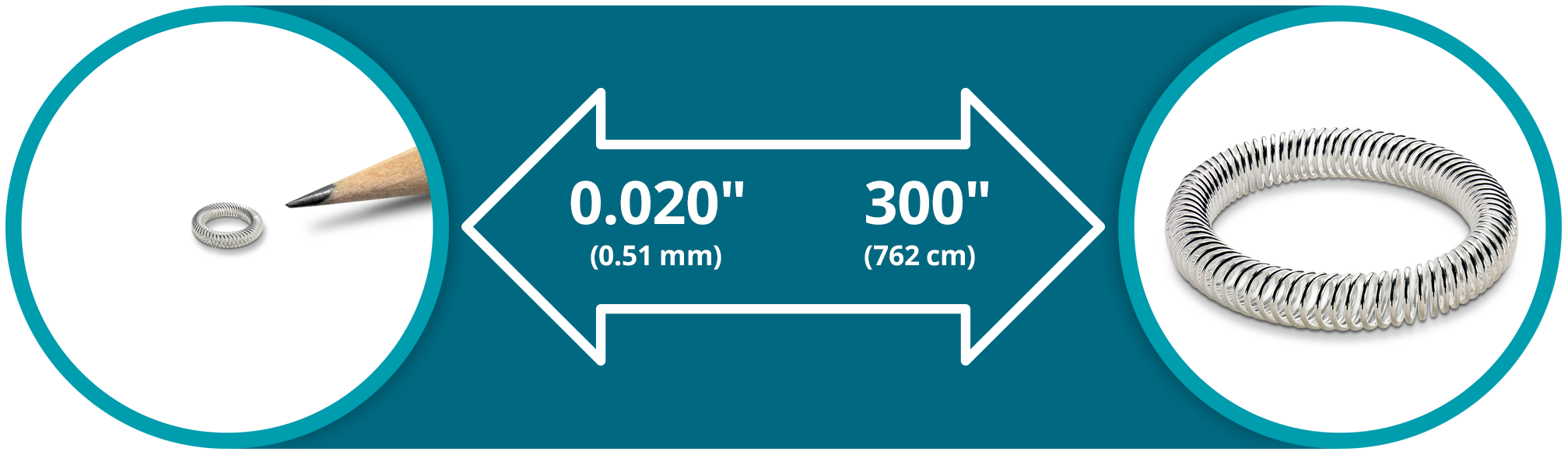
Images are provided solely as an illustration of common spring dimensions. Spring properties, including wire diameter, wire material, coil width, coil height, coil cant angle, spring ID/OD, and plating can be precisely customized for optimal performance.
EMI Shielding Spring Orientation
Radial Spring
Compression force of a radial canted coil spring is along the radius of the arc or ring, perpendicular to the centerline.

Axial Spring
Compression force of an axial canted coil spring is along the axis of the arc or ring, parallel to the centerline.

Service conditions, spring configuration (length or ring), and other factors can influence this design choice. Our engineers will help you to deternine which spring orientation desivers the best performance.
One Component, Three Functions
Some designers use the Bal Spring® canted coil spring to mechanically latch, lock, or hold critical machine components. Some use it to shield against EMI/RFI. Others leverage our spring’s ability to electrically conduct and ground. No matter how you choose to use it, you’ll increase performance, improve reliability, and gain a competitive edge.
EMI Shielding Spring Applications
Bal Spring® EMI shielding springs are engineered into critical electronic systems across industries where electromagnetic compatibility and reliable RF shielding are essential for regulatory compliance and system performance.
Defense & Aerospace Electronics
Radar systems, electronic warfare equipment, secure communications enclosures, avionics modules, and satellite electronics require MIL-spec shielding that performs under extreme shock, vibration, temperature cycling, and altitude conditions where conventional gaskets fail.
Telecommunications & 5G
Base station electronics, small cell enclosures, RF filter assemblies, and network infrastructure equipment operating at mmWave frequencies demand high-frequency shielding solutions that deliver consistent attenuation above 10 GHz without degradation over extended outdoor service life.
Medical Electronics
MRI systems, patient monitoring equipment, surgical robots, and portable diagnostic devices must meet strict EMC regulatory requirements while operating in electromagnetically noisy hospital environments. Clean, particle-free canted coil spring shielding protects sensitive circuits without contamination risk.
Automotive & EV Electronics
ADAS sensors, EV power electronics, infotainment systems, and autonomous driving modules require robust EMI shielding that maintains performance under vehicle vibration, thermal cycling, and the dense electromagnetic environment of modern vehicle electrical architectures.
Industrial & Test Equipment
Sensitive measurement instruments, RF test enclosures, industrial control electronics, and power conversion equipment benefit from the canted coil spring’s consistent shielding performance and resistance to the environmental contaminants common in industrial settings.
Consumer & IoT Electronics
Wearable devices, smart home hubs, wireless access points, and compact IoT modules require miniature EMI shielding solutions that deliver effective attenuation in space-constrained packages without adding significant weight or assembly complexity.
EMI Shielding Spring FAQs
A canted coil spring provides several advantages over traditional conductive elastomer gaskets and knitted wire mesh. The spring’s metallic construction eliminates compression set, so shielding effectiveness remains constant over the full service life without maintenance or replacement. Its near-constant force profile maintains consistent contact pressure regardless of tolerance variations, and it generates no particles or debris that could contaminate sensitive electronics. Third-party testing shows the Bal Spring® achieves lower transfer impedance than conventional gaskets, particularly at frequencies above 1 GHz.
Bal Spring® EMI shielding springs deliver effective attenuation across a broad frequency spectrum from 100 MHz through 16 GHz and beyond. Independent testing per IEC 61726 demonstrates shielding effectiveness that closely tracks the noise floor throughout these ranges. The spring is particularly effective at high frequencies (above 1 GHz) where conventional gaskets often show degraded performance — making it ideal for 5G, radar, satellite, and other high-frequency applications.
Bal Spring® EMI shielding springs are manufactured from beryllium-copper and zirconium-copper for maximum conductivity, or from stainless steel (302, 316, 316L) when higher mechanical force is required. Springs can be plated with gold, silver, nickel, or tin to enhance conductivity and corrosion resistance. Silver plating is typically preferred for maximum shielding performance, with protective coatings available for corrosive environments. All springs can be supplied to MIL specifications.
Four primary groove types are used with EMI shielding springs: rectangular (easiest to machine), dovetail (best for self-retaining the spring), tapered (best control of forces), and V-groove (best conductivity and lowest contact resistance). The optimal groove design depends on your enclosure geometry, required shielding performance, assembly method, and whether the spring also serves a mechanical connecting function. Bal Seal engineers will recommend the groove configuration that best balances shielding effectiveness with your manufacturing and assembly requirements.
Yes. The Bal Spring® canted coil spring can simultaneously provide EMI/RFI shielding, electrical grounding, and mechanical latching, locking, or holding — all from a single component. By adjusting the spring groove geometry, spring size, and wire characteristics, our engineers can optimize the spring to deliver both the shielding attenuation and the mechanical retention force your design requires, eliminating the need for separate gaskets and fasteners.
Start by defining your target frequency range, required attenuation level, enclosure geometry (ring or length, housing or piston mount), mating surface materials, environmental conditions (temperature, humidity, vibration), and any additional functions needed (grounding, mechanical retention). Bal Seal engineers will design a custom canted coil spring shielding solution optimized for your EMC requirements. Contact our engineering team to begin the design process.
Request EMI Shielding Spring Engineering Support
Every Bal Spring® EMI shielding spring is custom designed for your specific frequency range, attenuation requirements, and enclosure geometry. Our shielding engineers will evaluate your EMC challenges and design a canted coil spring solution that delivers superior attenuation, eliminates compression set, and simplifies your assembly. From initial concept through prototyping and production, we deliver the precision shielding performance your electronics demand.
Technical Resources
Product Catalog
Application Bulletin

Technical Report