
The Bal Contact® electrical contact helps designers connect with confidence. The compact, efficient contact manages high, medium, and low current with unmatched reliability, dramatically improving equipment performance and reducing costly downtime. The contact’s spring element, with its individual coils, compensates for misalignment and surface irregularities, delivering superior multi-point contact and conductivity with minimal heat rise – even in high shock and vibration.
Depending on application requirements, the Bal Contact can range in diameter from 0.053 in (1.35 mm) to 8 in. (203.2 mm) or more. It can be constructed from standard or implantable grade/biocompatible metals and alloys for use in medical implantables (see Bal Conn), and it can even be supplied in a system that incorporates silicone seals for dielectric isolation (see SYGNUS implantable contact system). Uses for the Bal Contact range from lead interconnects in active medical implantables, to busbar connections in aerospace equipment, and power transmission in satellite solar arrays.
Spring-Loaded Contact Technology
At the core of every Bal Contact® solution is proven Bal Spring canted coil spring technology functioning as a spring-loaded electrical contact element. Unlike solid pin-and-socket designs that rely on single-point contact, our spring-loaded contacts create multiple independent contact points that:
Provide Redundant Electrical Pathways
Multiple independent coils ensure reliable connectivity even if individual contact points are damaged or contaminated
Compensate for Tolerances
Independent coils adjust to dimensional variations, surface irregularities, and angular misalignment
Maintain Consistent Contact Force
Near-constant spring force characteristics maintain reliable contact pressure over thousands of mating cycles
Resist Fretting Corrosion
Self-cleaning micro-motion between spring and substrate disrupts oxide formation, maintaining low resistance
Enable Compact Designs
High power density manages more current in less space compared to conventional contact technologies, with minimal heat rise
This technology enables smaller, more reliable electrical connectors that outperform conventional contact designs in demanding applications.
Bal Conn® Electrical Connectors
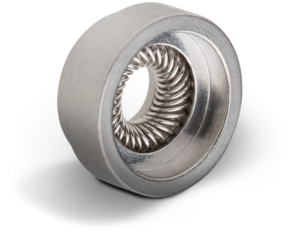
Our Bal Conn® electrical connector is the component of choice for designers who need to make reliable, consistent connections in active medical implantables for cardiac rhythm management and neuromodulation.
For more than 20 years, Bal Conn® has been improving device performance, supporting emerging therapies, and making smaller, more functional devices possible. Its uncompromising conductivity and compact design make it ideal for use in devices with high connection counts.
Design & Construction
Consisting of a housing made from medical-grade alloys and a Bal Spring® canted coil spring, the Bal Conn electrical connector is precision-built to help device designers connect with confidence. Its spring coils ensure ultra-reliable multi-point electrical contact with superior resistance to fatigue.
Bal Conn electrical connector housings are typically cylindrical, but their geometry can be customized to incorporate features that aid in connector retention and simplify assembly processes.
Performance Characteristics

Ultra-Low Contact Resistance

Typical contact resistance below 100 mΩ (as low as 15 mΩ achievable depending on materials and design)
Compact
Dimensions
Inside diameters from 0.024 in. (0.6 mm) to 0.39 in. (10 mm) and beyond
High
Reliability
Multi-point contact provides redundancy and fault tolerance
Biocompatible
Materials
Available in MP35N, platinum-iridium, titanium, and other implantable-grade alloys
Consistent
Forces
Insertional and removal forces remain consistent over the life of the product
Applications
The Bal Conn® enables transmission of power from the battery and electronics to the lead in implantable medical devices. Typically, multiple Bal Conn electrical connectors are arranged in a serial configuration as part of the interconnect system in a device header, or in an interconnect for a lead segment that helps reduce patient risk.
The connector’s canted coil spring element aligns with an electrode on the device lead, creating a reliable connection with very low contact resistance (<100 mΩ).
We offer Bal Conn electrical connectors in configurations that meet requirements for current and emerging neuromodulation technologies, as well as industry standards for implantable cardiac devices including IS-4 standards for pacing and defibrillation.
SYGNUS® Implantable Contact System
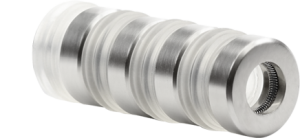
SYGNUS® is the world’s first integrated seal and electrical connector system for medical active implantable devices. It’s a plug-and-play solution for the critical lead interface, engineered to help you accelerate development and stay focused on what’s important to your business.
System Overview
The SYGNUS system combines ultra-reliable electrical connector technology with implantable-grade silicone isolation seals to create a serial “stack” that’s both compact and scalable. SYGNUS lets you confidently integrate proven interconnect components AND satisfy demand for smaller, more functional devices — while eliminating the need for dual sourcing or internal component development.
Electrical Connector Technology
The SYGNUS system’s core technology is the Bal Conn electrical connector. Consisting of a housing made from medical-grade MP35N® nickel alloy and a platinum-iridium or MP35N® canted coil spring, the connector offers low insertion force and ultra-low electrical impedance (<100 mΩ).
SYGNUS electrical connector housings are typically cylindrical, but their geometry can be customized to incorporate features that aid in connector retention and simplify assembly processes.
Compact Design
SYGNUS is engineered to minimize axial pitch, allowing for greater connector density in less space. Pitch distance, housing diameter, spring diameter, and housing geometry are completely customizable. The system accommodates lead diameters down to 0.6 mm, enabling high connector density in miniaturized implantable devices.
Integrated Sealing
Between the SYGNUS system’s connectors, precision-engineered silicone seals provide superior fluid and dielectric isolation, preventing leakage and current transfer that could cause device malfunction or failure.
Medical Implantable Applications
In devices used to deliver cardiac rhythm management and neuromodulation therapies, the SYGNUS implantable connector system enables the transmission of power from the device battery and electronics to the lead. The highly conductive canted coil spring element in each connector aligns with electrodes on the lead, reliably and consistently managing electrical pulses with minimal heat rise.
The system’s silicone seals help prevent fluid ingress, and ensure that channels with different functions don’t interfere with one another. While the SYGNUS system is typically incorporated into the device header, it’s also an ideal solution for inline connections that allow for faster, safer lead replacement.
SYGNUS is designed exclusively for:
Cardiac Rhythm Management

Pacemakers, ICDs, lead interfaces (IS-4 compliant)
Neuromodulation
Systems

Spinal cord stimulators, deep brain stimulators, sacral nerve stimulators
Ventricular Assist
Devices

Power and signal transmission for VADs and cardiac support systems
Implantable
Drug Pumps

Reliable connectivity in implantable infusion systems
Bal Contact® Applications Across Industries
Beyond medical implantables, Bal Contact® and Bal Conn® spring-loaded contact technology serves aerospace, defense, and industrial applications requiring reliable electrical connectivity in demanding environments.

Aerospace & Defense
Avionics Connectors
Flight control systems, navigation electronics, communication systems
EMI-Shielded Enclosures
Electrical contacts with integrated EMI/RFI shielding
High-Reliability Power Distribution
Engine systems, battery backup, critical power systems
Arming Systems
Reliable connectivity under shock and vibration

Industrial & Commercial
Automated Test Equipment
Probe contacts and high-cycle test fixture connections
Robotic Quick-Change Tooling
Power and signal contacts for modular end-effectors
High-Current Battery Interfaces
Rechargeable battery packs, power tool battery contacts
Instrumentation Connectors
Sensor connections, process control interfaces
Electrical Connector Frequently Asked Questions
An electrical contact is the conductive element that creates the actual electrical connection—typically a spring, pin, or socket that touches mating surfaces. An electrical connector is the complete assembly including contacts, housings, seals, and retention features. Bal Seal specializes in spring-loaded contact technology that provides the critical connectivity within connector systems, delivering reliable multi-point electrical contact that connector assemblies depend upon.
Spring-loaded contacts create multiple independent contact points compared to single-point contact in solid designs. This provides redundant current paths, maintains connectivity if individual points are damaged, distributes current to reduce heating, and compensates for tolerances and surface irregularities. Contact resistance remains low (<100 mΩ) throughout service life, and consistent contact force is maintained over thousands of cycles.
Bal Conn® and SYGNUS® connectors are available in implantable-grade, biocompatible materials including MP35N (cobalt-chromium-nickel-molybdenum alloy), platinum-iridium, and titanium alloys for springs, with housings in MP35N and other medical-grade metals. Silicone seals meet biocompatibility requirements per ISO 10993. All materials support long-term implantation in cardiac and neuromodulation devices.
Current capacity depends on contact spring material, number of contact points, contact force, plating materials, and application environment, among other factors. Individual spring-loaded contacts typically handle 1-10 amperes continuous current. Higher currents require multiple parallel contacts or contact designs optimized for power applications. For instance, we can reach higher values for bigger connectors, like a maximum 4900A for a 90mm pin. Our engineers calculate current capacity based on allowable temperature rise.
Yes, spring-loaded contacts excel in vibration environments because the spring force maintains contact pressure despite vibrational movement. Multiple independent contact points provide redundancy—if vibration momentarily disrupts one contact point, current continues through remaining contacts. This prevents intermittent disconnection common with single-point contact designs. Aerospace and defense applications routinely specify spring-loaded contact technology specifically for vibration resistance.
Yes, custom connector design is a core Bal Seal Engineering capability. We collaborate with your engineering team to develop connector solutions optimized for your unique requirements including custom contact configurations, housing geometries, integrated sealing elements, specialized materials, unique plating combinations, and application-specific testing. Our custom engineering process ensures your connector delivers optimal performance while meeting cost and schedule objectives.
Custom Connector Design
Bal Seal Engineering’s connector solutions combine decades of spring technology expertise with electrical design knowledge to create reliable connectivity solutions for demanding applications. Using our proven collaborative engineering process, we work closely with your team to develop, prototype, test, and manufacture electrical connectors that enhance your product performance.