Our versatile Bal Spring® canted coil spring is a proven, custom-engineered solution for mechanical connecting challenges in aerospace, medical, defense, and industrial applications. Its size, simplicity, and multi-function capabilities can help you reduce system complexity and weight while improving performance. The Bal Spring performs latching, locking, and holding functions, it allows for tool-less installation, and it’s robust enough to withstand thousands of insertion/removal cycles.
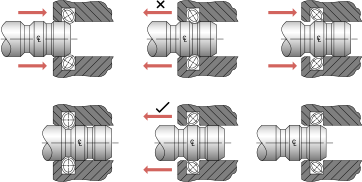
Latching
Fastening two device parts together while facilitating removal and replacement over many cycles
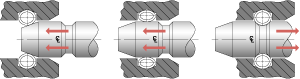
Locking
Permanently mating two device parts together, making removal impossible without damage to the part or spring
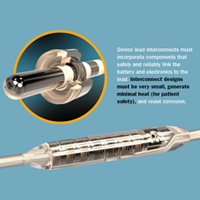
Holding
Retaining and aligning device parts and facilitating sliding function through the use of controlled spring force
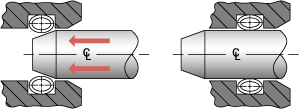
Locking & Quick-Release
Locking device parts together, with the option to advance and bypass lock for easy, low-force release
What Is a Canted Coil Spring for Mechanical Connecting?
A canted coil spring is an engineered garter spring with elliptical coils oriented at an angle to the spring’s centerline. This unique geometry produces near-constant force across a wide deflection range — a behavior conventional compression springs and wave springs cannot replicate. When used for mechanical connecting, the Bal Spring® canted coil spring functions as a latching, locking, or holding device that replaces complex multi-component fastening assemblies with a single precision-engineered spring.
Bal Spring® mechanical connecting springs are custom manufactured from stainless steel, MP35N®, titanium, Hastelloy®, Inconel®, beryllium-copper, and other high-performance alloys. Each spring is designed and sized for your specific force requirements, hardware geometry, and environmental conditions — from surgical instruments and defense electronics to oil and gas downhole tools.
Why Choose Canted Coil Springs for Mechanical Connecting?
Design engineers choose Bal Spring® canted coil springs over conventional fasteners, snap rings, and thread-locking mechanisms when they need reliable mechanical connections with fewer components, lower assembly weight, and consistent force over thousands of cycles.
Constant Force & Cycle Life
The canted coil spring’s near-constant force-deflection profile means latching and holding forces remain consistent from the first cycle to the 10,000th. Spring materials resist compression set and fatigue, eliminating force degradation that can plague other fastening solutions over time.
System Simplification & Weight Reduction
A single canted coil spring can replace screws, snap rings, retaining clips, and multi-part locking mechanisms. This reduces component count, simplifies assembly, enables tool-less installation and removal, and significantly reduces system weight — critical advantages in aerospace, medical devices, and portable equipment.
Multi-Function Capability
Beyond mechanical connecting, the same Bal Spring® canted coil spring can simultaneously provide EMI/RFI shielding and electrical conductivity. One component performing three functions — mechanical, electrical, and shielding — further reduces part count and design complexity in space-constrained applications.
Mechanical Spring Force
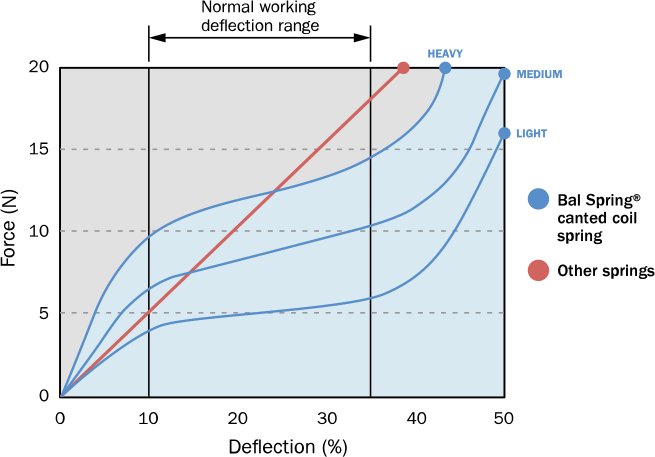
The Bal Spring® canted coil spring exhibits a unique deflection and force behavior when it’s compressed. Unlike typical spring technologies, our spring exerts a near-constant force across the working deflection range, and its forces remain consistent – even in wide temperature ranges. It resists compression set, and its individual coils compensate for misalignment, tolerance variations, and mating surface irregularities. By adjusting the spring groove, spring size, wire diameter and other characteristics, we can precisely control the force it takes to latch, lock, hold, connect, and disconnect. Spring forces can be precisely controlled from less than .5 lb. to >10,000 lb.

Mechanical Spring Materials & Plating
Our Bal Spring® canted coil spring is available in a variety of wire materials and surface finishes to meet specific performance demands. To reduce the potential for corrosion between dissimilar metals, we can plate springs with a galvanically compatible material.
Wire Materials Include:
- STAINLESS STEEL (302, 316, 316L)
- MP35N®
- PLATINUM IRIDIUM
- TITANIUM
- HASTELLOY®
- INCONEL®
- BERYLLIUM-COPPER
- ZIRCONIUM-COPPER
Plating Options Include:
- GOLD
- SILVER
- NICKEL
- TIN
Mechanical Spring Sizes
Our Bal Spring® canted coil springs are available in a range of non-welded lengths (for simple or complex groove configurations), and in welded rings from 0.020 in. (.51 mm) ID. Since every spring is designed to meet the unique requirements of your application, we don’t stock a “standard” size and type. But we do maintain a database of commonly-requested diameters and cross-sections, which can serve as a baseline for streamlined customization.
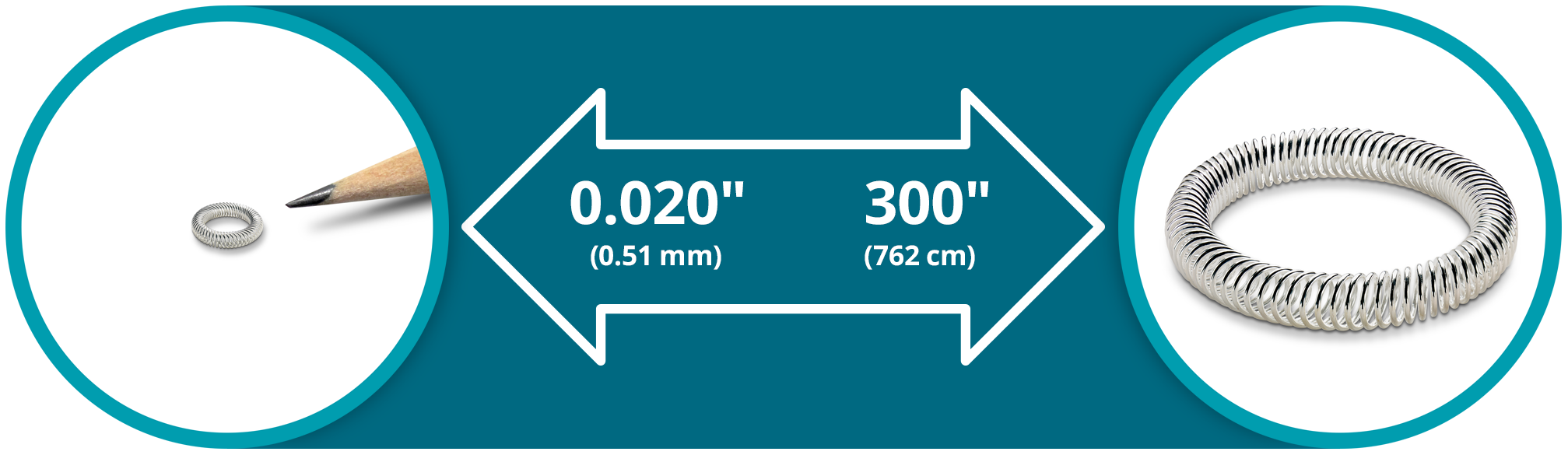
This chart is provided solely as an illustration of common spring dimensions. Spring properties, including wire diameter, wire material, coil width, coil height, coil cant angle, spring ID/OD, and plating can be precisely customized for optimal performance.
Mechanical Spring Orientation
Our Bal Spring canted coil spring can be designed with coils that deflect in an axial or radial orientation. This makes it possible to optimize the direction of the force in your design, ensuring effective, long-term service. For housing or piston mounted designs, a radial spring orientation is typically recommended. Axial springs are often specified for face mounted installations.
Radial Spring
Compression force for a radial canted coil spring is along the radius of the arc or ring, perpendicular to the centerline.

Axial Spring
Compression force for an axial canted coil spring is along the axis of the arc or ring, parallel to the centerline.

Service conditions, spring configuration (length or ring), and other factors can influence this design choice. Our engineers will help you to determine which spring orientation delivers the best performance.
One Component, Three Functions
Some designers use the Bal Spring® canted coil spring to mechanically latch, lock, or hold critical machine components. Some use it to shield against EMI/RFI. Others leverage our spring’s ability to electrically conduct and ground. No matter how you choose to use it, you’ll increase performance, improve reliability, and gain a competitive edge.
Mechanical Spring Applications
Bal Spring® canted coil springs for mechanical connecting are engineered into critical assemblies across industries where reliable latching, locking, and holding performance is non-negotiable.
Aerospace & Defense
Avionics module latching, missile component retention, satellite assembly quick-release mechanisms, and aircraft panel fastening demand springs that deliver consistent force under vibration, thermal cycling, and extreme G-loads.
Medical Devices & Surgical Tools
Surgical handpiece couplings, endoscope component latching, catheter assemblies, and reusable instrument connections require biocompatible springs that maintain precise engagement force through thousands of sterilization and use cycles.
Oil, Gas & Energy
Downhole tool locking mechanisms, subsea connector retention, wellhead component latching, and turbine assembly holding applications operate under extreme pressures, temperatures, and corrosive media where spring reliability is mission-critical.
Industrial & Automation
Robotic tool changers, pneumatic quick-connect fittings, modular fixture latching, and automated assembly systems benefit from tool-less spring connections that speed changeover and reduce downtime on production lines.
Electronics & Communications
Circuit board retention, battery contact springs, modular enclosure latching, and rack-mount equipment connections leverage the canted coil spring’s dual mechanical-electrical capability to simplify designs and reduce assembly steps.
Automotive & Transportation
Sensor housing retention, fuel system component locking, EV battery module connections, and powertrain assembly holding applications require springs that withstand vibration, thermal cycling, and high cycle counts in demanding vehicle environments.
Mechanical Connecting Spring FAQs
Latching fastens two parts together while allowing repeated removal and replacement over many cycles. Locking permanently mates two parts, making separation impossible without damaging the spring or component. Holding retains and aligns parts while allowing controlled sliding motion through the spring. Each function requires different spring force characteristics, groove designs, and hardware geometries that Bal Seal engineers optimize for your specific application.
The canted coil spring has an elliptical cross-section with coils oriented at an angle to the spring’s centerline. This produces near-constant force across the working deflection range, unlike conventional springs where force increases linearly with compression. The individual coils deflect independently, compensating for wear, misalignment, and tolerance variations. This results in consistent engagement force over thousands of cycles and significantly longer service life than standard garter springs, wave springs, or snap rings.
Bal Spring® canted coil springs for mechanical connecting can be precisely engineered to deliver forces from less than 0.5 lb to over 10,000 lb. Force is controlled by adjusting wire diameter, wire material, coil geometry, spring groove dimensions, and spring size. Our engineers work with your team to define the exact force profile needed for reliable latching, locking, or holding in your application.
Bal Spring® canted coil springs are manufactured from a range of high-performance wire materials including stainless steel (302, 316, 316L), MP35N®, platinum iridium, titanium, Hastelloy®, Inconel®, beryllium-copper, and zirconium-copper. Springs can be plated with gold, silver, nickel, or tin for galvanic compatibility, corrosion resistance, or enhanced conductivity. Material selection is driven by your application’s temperature, chemical, biocompatibility, and mechanical requirements.
Yes. A single Bal Spring® canted coil spring can replace screws, snap rings, retaining clips, thread-locking compounds, and multi-part fastening assemblies. The spring installs into a simple groove, enables tool-less assembly and disassembly, and provides consistent retention force without the loosening, fatigue, or corrosion issues common with threaded fasteners. This reduces component count, assembly time, system weight, and long-term maintenance costs.
Start by defining your connection type (latch, lock, or hold), required force, cycle life, operating environment, and hardware geometry. Bal Seal engineers will evaluate your requirements and design a custom canted coil spring optimized for your application — from initial concept through prototyping and production. Contact our engineering team to begin the design process.
Request Mechanical Spring Engineering Support
Every Bal Spring® mechanical connecting spring is custom designed for your specific latching, locking, or holding application. Our spring design engineers will evaluate your force requirements, hardware geometry, environmental conditions, and cycle life targets to create a solution that simplifies your design and outperforms conventional fastening methods. From concept through production, our custom spring manufacturing delivers the precision your applications demand.
Technical Resources
Product Catalog
Application Bulletin
Technical Report